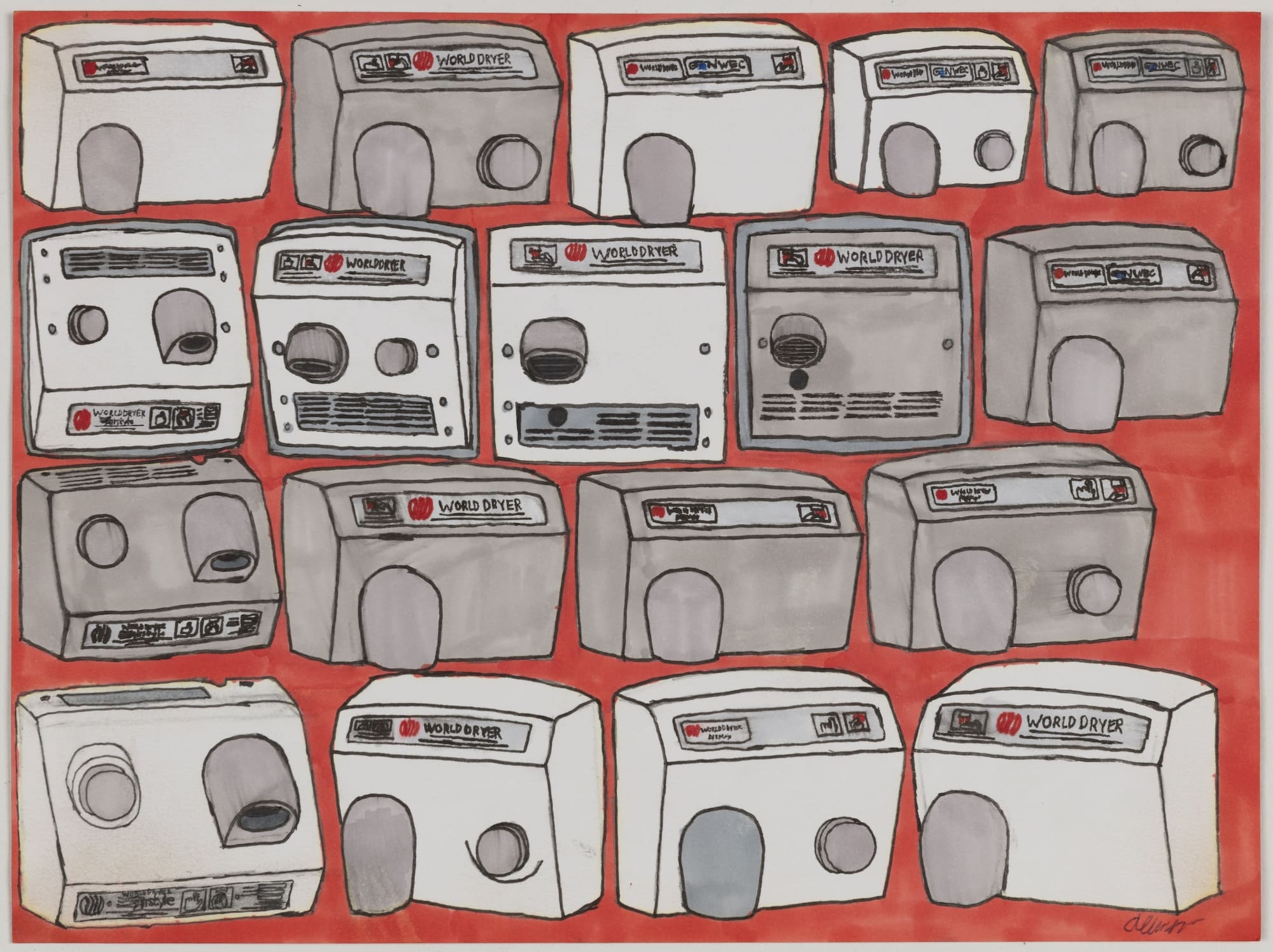
“LOOK HERE,” an art exhibition showcasing work from six artists from Center for Creative Works, or CCW, will open in the Cantor Fitzgerald Gallery on September 19. The CCW is a progressive art studio that has a longstanding community partnership with Haverford’s Critical Disabilities Studies course. “LOOK HERE” is an exhibition about the different ways we “look” at the world around us, and how that shapes the creative process and the very nature of art-making. It includes art by Kelly Brown, Cindy Gosselin, Clyde Henry, Tim Quinn, Brandon Spicer-Crawly, and Allen Yu.
When Kristin Lindgren, professor of writing, developed the Health Studies 304 course, “Critical Disabilities Studies: Theory and Practice,” she imagined it as a course that worked closely with a community partnership. She and her students soon identified the Center for Creative Works (CCW), which has a studio just down Lancaster Avenue, in Wynnewood, PA. The Center for Creative Works is a progressive art studio, or a collective made up of artists with intellectual disabilities.
“It occurred to us, to me and the students doing this, that these are two communities that don’t interact,” Kristen Lindgren said, “Like we’re a mile away, but Haverford is its own little bubble and CCW artists do their own thing. And we’ve really built a relationship with our communities over time.”

For the past decade, Professor Lindgren’s Critical Disabilities Studies course has developed a close relationship with CCW. The two organizations collaborate each Spring, with the semester culminating in a small art exhibition on Haverford campus every year.
The relationship between Lindgren and her students and CCW was strong, but they always dreamed of curating a larger exhibition of work to be displayed on Haverford campus. Then, Matthew Callenan, the exhibitions manager at the Hurford Center, reached out to Kristin Lindgren and Samantha Mitchell, the exhibitions manager at CCW, to ask them to bring a larger exhibition to the Cantor Fitzgerald Gallery. Lindgren and Mitchell applied to the Pew Center for Arts and Heritage for the funding and have spent two years now designing and executing their vision, which includes three exhibitions, a symposium, and a book about the work of progressive art studios. The curators of the “LOOK HERE” exhibition are Jennifer Gilbert, Mary T. Bevlock, and Paige Donovan.

“LOOK HERE” is a multi-media exhibition with a strong focus on the way different abilities can lead to different practices of art making. Alongside the art, the exhibition also includes videos of each artist’s creative process. Cindy Gosellin, who works mostly in fiber art sculpture, is shown walking around a sculpture, wrapping it in thread. Professor Lindgren described Gosellin’s practice as being shaped by her blindness. “It’s this kinetic and tactile mode of walking around, feeling it, asking questions of others around her. So the art practice itself is different,” said Lindgren.
Different approaches lead to art that looks different, and is received differently by the viewer. Lindgren went on to say, “I believe that our own embodied experiences and the way we think shapes the art we make. I’m very interested in how neurodivergence brings new ideas to art making.”

Another goal of “LOOK HERE” is to challenge the misconception that neurodivergent artists are “outsider artists,” a term often associated with those who were not trained in art school. The connotation of “outsider artists” implies isolation from the art world and a lack of education in art history. This is untrue of the artists who work with CCW. They are a part of the larger art world and receive acclaim for their art, independent of their disability status.

Curator Jennifer Gilbert has worked hard to make the exhibition as accessible as possible. The videos in the exhibition feature American Sign Language. The wall text is paired with braille and audio descriptions. Smaller swatches or pieces of sculpture are available to feel and touch, so that visitors can have a tactile experience of the art.
“We’re trying to make it not just multimedia, but multi-sensory, so that people can access it in different ways. And we really want to model for other galleries and museums how they might think about access,” said Lindgren.
Professor Lindgren emphasized the support she’s received for her projects from the Hurford Center over the years. Before VCAM was built, they installed temporary walls in the Zubrow Lounge to hang artwork for CCW exhibitions. Grants from the Hurford Center have allowed the Critical Disabilities class to publish catalogues of their exhibition works and run workshops and symposiums of people who specialize in progressive art studios.
“LOOK HERE” opens on September 19 and will run until December 13, 2025. It is in the Cantor Fitzgerald Gallery on Haverford Campus. The gallery opening and a reception with an opening talk will take place from 4:30 to 7:30 PM in the Cantor Fitzgerald Gallery in Whitehead Campus Center.

1 comment
I’m looking forward to attending the show at some point soon. I became aware of the Center for Creative Works while at the annual Outsider Art Fair in NY. (I appreciate your comment about use of that category but the moniker isn’t going to change anytime soon).
My question — will any of the art be available for sale?
Although I live closer to Princeton these days, so much of my life is still centered in Philadelphia. The trek to Haverford — no big deal.
Great exhibit idea! Hope to see you all soon.