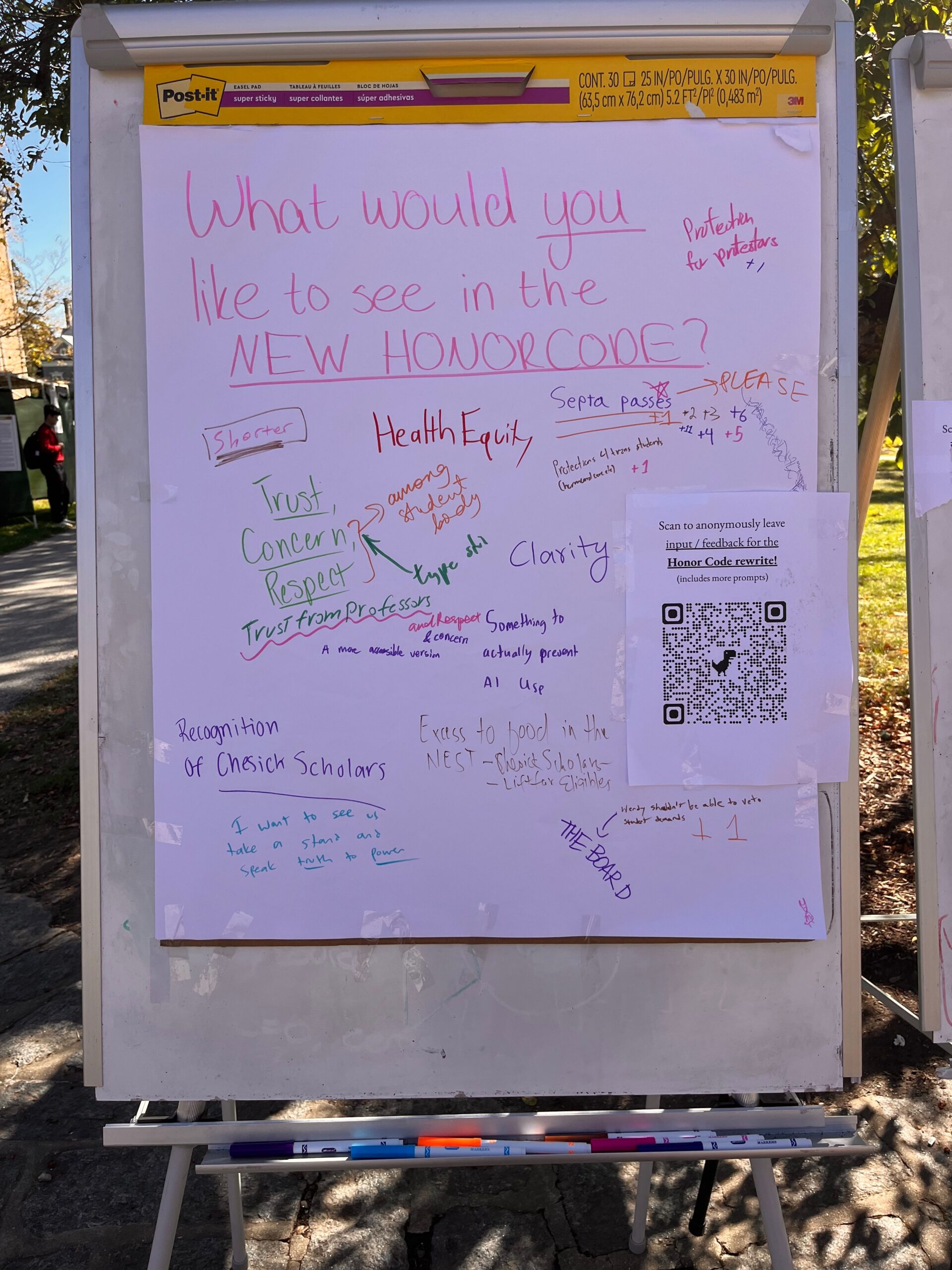
As part of their ongoing work in rewriting the Haverford Honor Code, the recently formed Committee for Student Community Agency and Responsibility (CSCAR) placed large blank posters outside the Dining Center with the header, “What would you like to see in the NEW HONOR CODE?” in order to gather feedback from the community on what they might like to see highlighted in the newest articulation of our student body’s social and academic values.
The written commentary accumulated on the posters by the end of the day gave the impression that much of our community, at least those members who wrote on the posters, are unclear about what exactly the Honor Code looks like.
Some notes gave relevant responses, including a desire for the code to be shorter, more clearly articulated, and written in more accessible language. Several emphasized the need for a focus on how to foster trust between professors and students in an age of AI.
Other notes, however, asked that the new Code advocate for the gym to be open on weekend mornings, or that the Dining Center serve food at later hours. One comment asked for SEPTA passes to be supplied for students, a request already brought up in a plenary resolution last spring, and denied by President Raymond. Another read, “pay student workers a fair wage!” which was also addressed in a plenary resolution in the fall of 2023 that raised the wage by $1.75. Notwithstanding the fact that these complaints have been addressed through other avenues, it is crucial to make clear that the Honor Code does not create or propose new financial policies for the College.

(Bi-Co News/Jessica Schott-Rosenfield)

Ben Perez-Flesler ’27, one of the CSCAR Co-Heads alongside Sofie Quirk ’28 said of the comments in general, “I think a lot of it broadly agrees with our visions for the code a well, which is nice to see — that there is a general community consensus around the problems that we have and what we want to see in the future … overall we want something that’s clearer and more direct, easier to understand, more accessible … our code is currently about 55 or so pages long in total and I think we’re probably — at the end of this — looking at something that’s closer to ten.”
Of the apparent misconceptions regarding the Honor Code’s content, Perez-Flesler said that by the end of the process the committee is looking forward to offering “a better definition of the particular purpose of the Code and what the constraints around that are.” The alternate avenues for policy change that serve other suggestions made on the posters will hopefully be clarified as well, he added.
Following fall break, during which time committee members are drafting their initial revisions, CSCAR will be printing out their proposed language, and posting them around campus for students to provide feedback.
Love the Bi-College News? Want to support independent student journalism? Donate to us.
