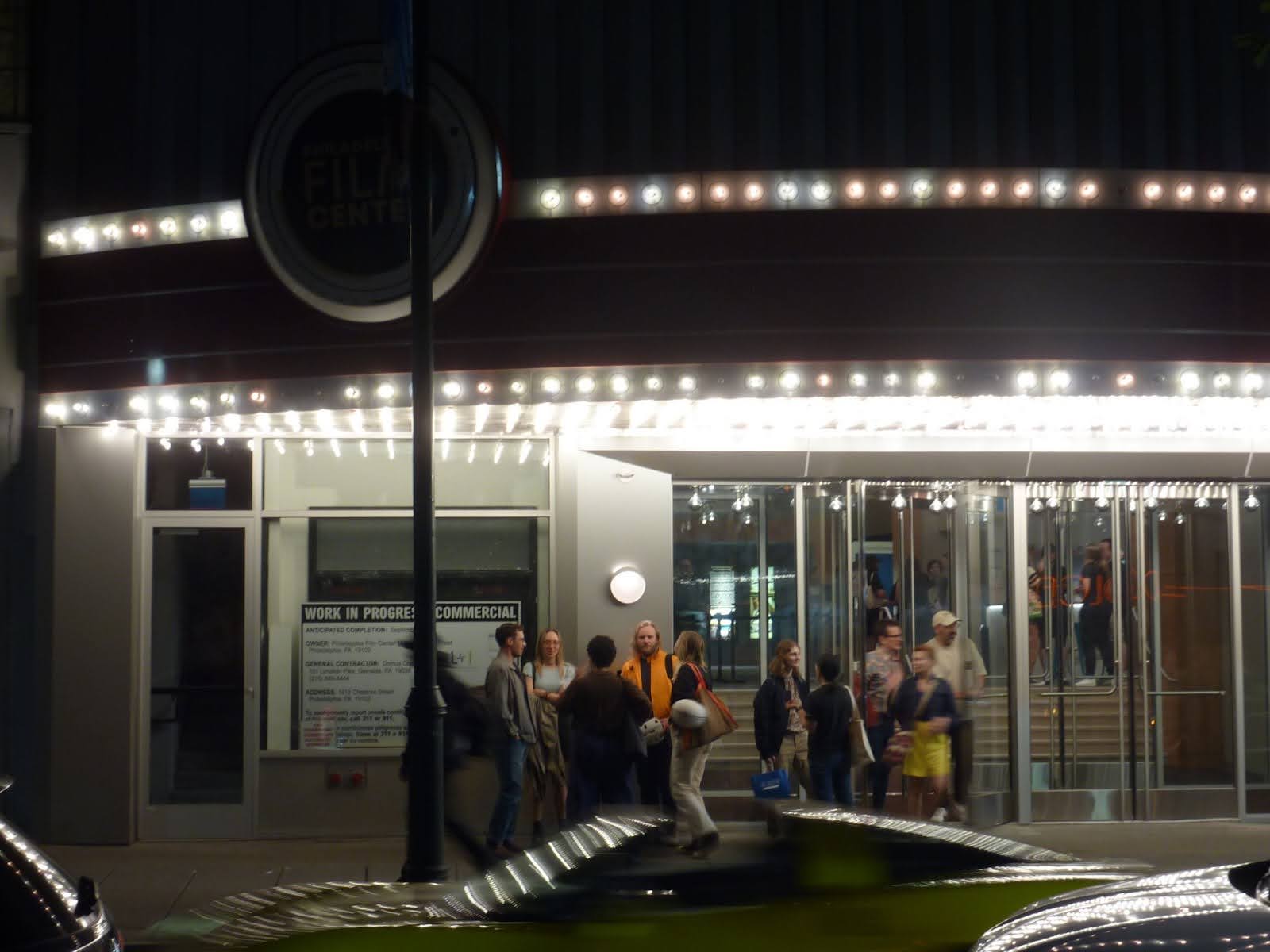
This past weekend, I attended a screening of David Lynch’s “Eraserhead” (1977) at Film Society Center in Philadelphia. One of the Philadelphia Film Society’s three operating theaters, the Center is located at 1412 Chestnut Street, a short walk from Jefferson Station. “Eraserhead,” shown from Friday, October 3, to Sunday, October 5, marked the beginning of a PFS curation titled “Deeper in Dreams: A David Lynch Retrospective,” which will go on through December.
Dates listed in the series include not only the bulk of Lynch’s eleven feature films, but documentaries such as “Lynch/Oz” (2022) and compilations like “The Short Films of David Lynch Part 1” and “ David Lynch Ads + Music Videos.” This latest installment is a continuation of the society’s effort to memoralize Lynch in the wake of his January passing. Last year’s series, “In Dreams,” entailed a curation of films known to be most formative towards Lynch’s aesthetic. These selections included but were not limited to “The Wizard of Oz” (1939), “Sunset Boulevard” (1950), “Vertigo” (1958), and “Lolita” (1962).
At the Sunday, October 5 “Eraserhead” screening, moviegoers of all ages packed the theater. From older couples reminiscing over having seen the film when it first came out, to the most recent generation of Lynch acolytes – some proselytized to the director’s oeuvre by Tumblr and its many off-sets, others by a parent, grandparent, or trusted friend – those in attendance seemed to have claimed their velvet-cushioned seats with not just excitement but purpose.
Lynch has described “Eraserhead” – his black and white, feature-length debut – as the most spiritual film he ever made. Based on some inexplicable feeling typical of spiritual experiences, I suppose this is so. The movie follows regular Lynch-collaborator Jack Nance as Henry, an awkward young man who discovers at a dinner with the family of his girlfriend, Mary, that she has given birth to his son. The baby, born drastically premature, is a reptilian, ghoulish creature whose relentless shrieking quickly disrupts all aspects of Henry’s already weary lifestyle. As Mary loses her nerve and leaves Henry to care for the child on his own, he is forced to reckon with conflicting instincts of protection and violence. Both endeared to and repulsed by the mutant baby, viewers find themselves trapped in a similar dilemma of cognitive dissonance.
Often interpreted as a manifestation of Lynch’s anxiety surrounding fatherhood – with his first child, Jennifer Lynch, born in 1968 – the film, in a broader sense, is pervaded by loneliness. Henry’s interactions with Mary, Mary’s eccentric family members, a woman across the hall, and, most viscerally, his infant son, convey an almost intolerable bleakness – alienation where there is meant to be connection. As the PFS notes, it is one the many worlds Lynch created “that were at once fascinating and unsettling, dreamlike and nightmarish, revealing the hidden paradoxes of human existence with unflinching honesty.”
When I first watched “Eraserhead,” I found it notable that some of the film’s most disturbing instances are not in the grotesque – such as a chicken on Henry’s plate suddenly animating and oozing blood, or Henry’s head launching out of his body and rolling onto the street. They are in the quotidian, everyday irritants which are turned up a single notch and thus made surreal. I feel this to be particularly severe in the family dinner scene; the dog nursing her pups, the mute and immobile grandmother, the meek father-in-law who stares too long, the anxious and invasive matriarch – all are heightened to something perverse. These little details of “Eraserhead” render uncomfortable not just fantastical violence and monstrosity, but life itself.
The sounds of the film play a major role in this effect. Always thrumming in the background, selectively drowning out dialogue, industrial noise is a palpable monster – perhaps the most unsettling monster of the production. In the 2001 documentary, “Eraserhead Stories” (also screened at the PFS this weekend), Lynch argues, “A sense of place is critical to a film, and sound, particularly, can expand, you know, what you’re seeing, and expand the world, and those things can break a mood or enhance a mood.” The sense of place Lynch intended to capture, evidently, was the very location of this weekend’s screening: Center City, Philidelphia, or, as fans lovingly term it, “Eraserhood.”
In the 1960s and 1970s, Philadelphia was in strife. Although today a functioning metropolis, the city then was a living crisis of urban renewal that had gone too far and morphed into urban decay. It was home to endemic squalor, gang violence, police brutality, economic collapse, and environmental catastrophe. Lynch, who lived in Philidelphia from 1965 to 1970, has described the city as “a hellhole,” lush with “insanity and a feeling in the air that was very uneasy.” He saw the horror of Philadelphia’s despair with a sharp, unrelenting eye. And yet, he looked upon such horror with a profound degree of tenderness.
During an interview with Time Magazine in 1990, Lynch remarked of Philadelphia: “It’s the sickest, most corrupt, decaying, fear-ridden city imaginable. I was very poor and living in bad areas. I felt like I was constantly in danger. But it was so fantastic at the same time.” In 2014, at a conference for the Pennsylvania Academy of the Fine Arts, where he studied for two years, Lynch declared, “I always say, Philadelphia, Pennsylvania, is my biggest influence. There is something about the mood here. The fear, insanity, corruption, filth, despair, violence in the air was so beautiful to me.”
In “Eraserhead Stories,” Lynch echoes this sentiment. “It sort of seemed like, to me,” he muses, “that there were factories, industrial buildings, and neighborhoods – dark and forlorn, tucked in somewhere…you can’t get there from here – they’re sort of lost in another kind of place. And this is what comes from Philadelphia. And this is the world of ‘Eraserhead’ – where you can be in a room and feel the exterior.”
The PFS’s decision to kick-off “Deeper in Dreams” with “Eraserhead” was, therefore, essential. Many have noted that Lynch’s succeeding work – from “The Elephant Man” (1980) to “Inland Empire” (2006) – progressively attempts to harness the magic of his debut feature. More importantly, Philadelphians in particular seem to claim a certain ownership over the film. At the October 5 screening, I was surprised and endeared by the way the audience’s scattered laughter at off-kilter moments grew fuller in body and the movie went on. The reaction resonated as not just an appreciation of Lynch’s subtle comedy but as the sharing, almost, of some inside joke – a joyful reverberation of the way “Eraserhead” lovingly disparages our city.
