Caren Beilin’s new novel, “Sea, Poison,” confronts corruption in the healthcare industry and the dark reality of medical crime. Simultaneously, the book is a metatextual exploration of tone, expression, and form.
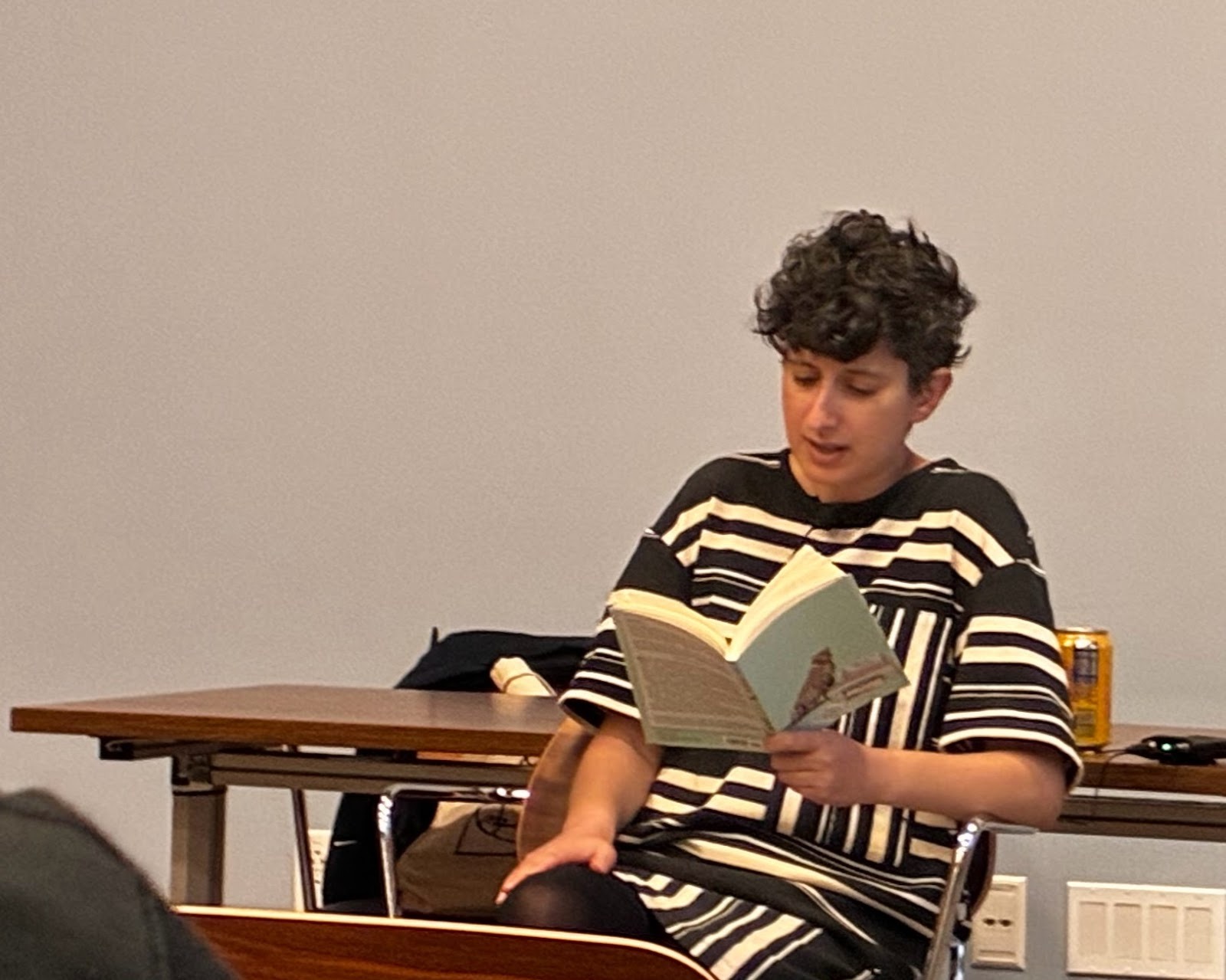
This Tuesday, Beilin gave a reading from “Sea, Poison,” in Lutnick Library and answered questions from students and the community.
I was introduced to Caren Beilin’s work completely by accident. I was in Portland, Oregon in 2023, visiting the famous bookstore Powell’s City of Books. I picked up “Revenge of the Scapegoat” from a shelf of books published by independent presses, inspired by the vivid painting on the cover. I spent the next two days tearing through the book, captivated by Beilin’s style while waiting in line at restaurants or riding the Portland Streetcar.
Caren Beilin seemed to be incredible at layering surprising images together, resulting in scenes that walk the balance between frustratingly mundane and ridiculously surreal. So, I was excited to pick up Beilin’s new novel, “Sea Poison,” which came out this October.
“Sea, Poison,” was written in response to Shusaku Endo’s novel “The Sea and Poison.” While Endo wrote about Japanese vivisection experimentation on American prisoners of war during World War II, Beilin shifts her novel to reveal the horror of medical crime committed against women, from unnecessary hysterectomies motivated by insurance fraud to sexual assault and rape in gynecologic settings.
Running parallel to this story of medical corruption is the story of Cumin Baleen, a character who clearly represents Caren Beilin herself. Beilin invents a plot in which Baleen becomes the subject of a twisted experiment that gives her brain damage, leaving her unable to write complex sentences with multiple clauses. A corrupt hospital seeks to profit from her now spare, minimalist writing style.
Philadelphia is a fitting backdrop for the story of medical crime. Beilin repeatedly refers to it as a city of hospitals. She writes: “There is no actual sea in Philadelphia. Only a veritable sea of hospitals…There’s poison.” As Philadelphians, Beilin believes we cannot get out of “seeing poison.”
Throughout “Sea, Poison,” Beilin explores different constraints on her writing. Beilin wrote the chapter “A Manager” using what she refers to as a kind of mad-libs process. She took a section from Endo’s “The Sea and Poison,” and swapped out each word for one of her own, making sure to mirror the original syntactic structure of each sentence. Endo is known to be a writer with a simple and clear style, one that would naturally contrast with Beilin’s tendency toward complicated prose.
When Beilin made her visit to Haverford, she chose to read the chapter “A Manager,” explaining its origin as a replication of “The Sea and Poison,” though the version that was published in “Sea, Poison” had undergone many revisions. As Beilin read, she conveyed the humor that shines through in her writing, even on more violent and emotional subjects. She sang the lyrics to punk songs included in the text, explaining that she had to speak them when recording the audiobook, having the rights only to the lyrics and not the music.
In “Sea, Poison,” Beilin includes graphic descriptions of medical crimes committed against women. She includes the true story of hysterectomies used as forced sterilization in an ICE detention center in Georgia and the crimes of Javaid Perwaiz, an obstetrician-gynecologist who told women he was performing hysterectomies to save them from cancer, while he was really running an insurance scam.
How do we face these medical crimes? For Beilin, the answer seems to be accessible through exploration of literary styles, especially through constraints.
At the end of “Sea, Poison,” Beilin layers the hysterectomies and writing constraints together and begins writing without the letters “u, t, e, r, u, s.” Beilin, through the writing of her character Cumin Baleen, enacts the process of unnecessary hysterectomy against her own art. The writing constraint is another form of needless experimentation. However, by acting out this literary hysterectomy, Baleen is healed. The writing constraint brings about the novel’s resolution and a solution to the writer’s block imposed on the narrator by the surgery designed to alter her writing style.
In “Sea, Poison,” Beilin forces a confrontation with the reality of medical crime, and emerges from this vision of medical “poison” with the conclusion that what really matters is to describe experience, to bear witness, and see poison.
