Ros Horin’s 2024 documentary “Welcome to Yiddishland” shines light on the global renaissance of Yiddish art – particularly in music and theatre – which has taken place over the past few decades. It argues that in our modern zeitgeist, where Jewish identity too often means either 20th century persecution or Israeli militarization, Yiddish offers a much-needed alternative. One of the film’s featured artists, Australian theatre and opera director Barrie Kosky, contends, “In the theater, there were two types of Jews: Dead, in a concentration camp, or in a [military] uniform, in Israel.” However, Kosky declares, “There is a whole world in between – and that world is Yiddish culture.”
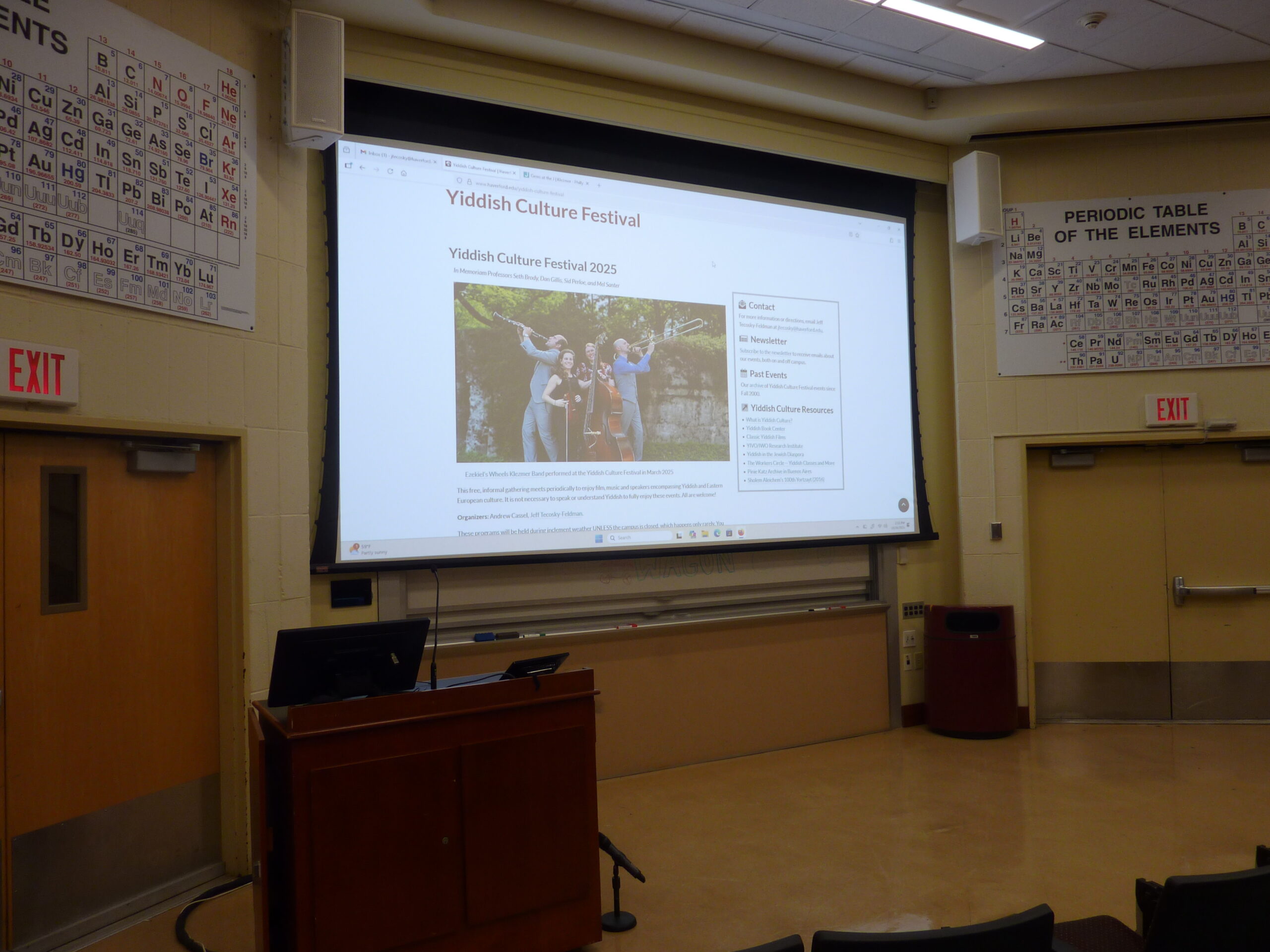
On October 26, Haverford’s ongoing Yiddish Culture Festival hosted a screening of “Welcome to Yiddishland.” Launched in 1995, the festival typically meets two to four times a semester. This year’s first event, a talk on “Philadelphia Yiddish Radicals of the Early 20th Century” by Temple University professor Geoffrey Baym, was held on September 7. Programming is run by Haverford Mathematics and Statistics professor Jeff Tecosky-Feldman, who continues the festival in memory of professors Seth Brody, Dan Gillis, Mel Santer, and Sid Perlow. Others, such as Bryn Mawr German professor Margaret Strair, also assist behind the scenes.
Although there were hardly any Bryn Mawr or Haverford students in attendance, Stokes Hall Auditorium quickly filled with about 40 to 50 yiddish-enthusiasts of the greater Philadelphia community. The screening’s atmosphere was tremendously warm and genuine, with casual conversation taking place before and after the film. Many audience members, largely of an older generation, seemed to be familiar with each other, and when Professor Tecosky-Feldman asked the crowd who among them was a first-time attendee to festival programming, only a sprinkling raised their hands.
While etymologically Yiddish is very close to German, it is also a composite of biblical Hebrew, Arabic, and various Slavic dialects. Having never belonged to any one nation identity, the language populated Eastern Europe via manifold waves of Jewish refugees. Although the popular assumption that Yiddish is a dead language is a myth, it is certainly an endangered language. After roughly half of the world’s Yiddish-speakers were killed in the Holocaust, Yiddish was further undermined by movements in the 20th century, such as Zionism, Stalinism, and assimilation.
From its early use, Yiddish has existed on the margins of both public regard and Ashkenazi Judaism. Whereas the Yiddish term for Hebrew, “loshn koydesh,” translates as father or holy tongue, Yiddish itself, “mame loshn,” translates as mother tongue. In the Eastern European shtetl, Hebrew was spoken exclusively in contexts of prayer or religious scholarship. Women, prohibited from such spaces, were not allowed to learn Hebrew. So, Yiddish became the language of the home, the language of women’s gossip, storytelling, and humor. Accordingly, attitudes towards Yiddish – though fluctuating – tend to align with those towards many feminized concepts or items in the Western imaginary.
Following the influx of Jewish immigration to the United States in the decades around WWII, Jewish-American Yiddish-speakers began to learn English and teach it to their children. Because Yiddish held connotations of poverty, European displacement, and femininity or emasculation, succeeding generations allowed the language to fade into a time and place from which many Ashkenazi Jews now find themselves divorced.
In an especially striking moment of “Welcome to Yiddishland,” another featured artist recounts a conversation with his Hungarian-Jewish grandmother in which she dismisses Yiddish as “a perversion of German.” The artist recalls mentioning to her that the Nazis employed this same rhetoric in 1930s Germany. His grandmother then responded, “[the Nazis] were right.”
Faced with a variety of stigmas, Yidischists today find themselves obligated to prove that Yiddish is definitively a language, not simply a dialect, a broken variant of German, or secret code among grandmothers. And yet, centuries of Yiddish culture have produced a rich, distinct tapestry of literature, including folklore, poetry, and theatre that has resounded across centuries. Even in the post-war landscape, literary giants and visionaries such as Philip Roth and Cynthia Ozick frequently incorporate or engage with Yiddish in their works. In 1978, Isaac Bashevis Singer, who wrote the original story, entirely in Yiddish, of “Yentl,” was awarded the Nobel Prize in Literature.
As “Welcome to Yiddishland” director Ros Horin told The Jewish Independent, “Yiddish isn’t a language of one nation state. It’s inclusive, it’s about Jewish culture, and it’s giving people a sense of belonging.” As a language that itself has been denigrated, Yiddish often functions as a gateway to radically progressive ideologies. Accordingly, the contemporary Yiddish art movement champions multi-vocality and social justice, offering those who find Judaism otherwise inextricable from mainstream Jewish politics an alternative way of connection.
Following the screening, some audience members shared anecdotes about their own experiences with Yiddish growing up; many of these attendees resonated with the intergenerational perception of Yiddish as lowly or embarrassing. Yet, a couple of individuals also felt it important to mention that cultural attitudes towards Yiddish are not monolithic across different nations. In their experiences of Yiddish-speaking Jewish households in Argentina and Mexico, for example, they shared that a pressure to assimilate was not nearly as central or powerful as it was in the United States. Yiddish was therefore regarded neutrally, as these Jewish communities existed in “a bubble.” After some respectful discourse between these individuals and those with contrasting experiences, one man remarked on the beauty of Yiddish proving itself to be a common thread among multi-national voices.
When I asked Professor Tecosky-Feldman why he has maintained involvement with the Yiddish Culture Festival for over two decades, he emphasized the memorialization of his former colleagues. Tecosky-Feldman’s precedents “started the Yiddish culture festival in 1995 with the idea being that it might attract students at Haverford who would be interested in learning Yiddish, and if they could get ten, twelve students interested in learning Yiddish, we could have Yiddish taught on campus.”
“So,” Tecosky-Feldman continued, “I was one of the people who came to the programs that they organized […] hardly any students came […] most of the people who came were people from the community […] who, like me, had interest in Eastern European culture and Yiddish language but weren’t necessarily fluent in Yiddish. And so, after I guess two or three years of coming to these events, I kind of got involved more like a producer. I said, let’s have an email list, let’s send out a program, to sort of regularize it. And so I kind of joined the team, at that point probably in 1998 or so.”
Tecosky-Feldman also shared that the festival provides a connection to his Yiddish-speaking grandmother, whom he “was very fond of.” Still, like many of the documentary participants and audience members, Tecosky-Feldman noted that, prior to learning about Yiddish culture through the festival, Yiddish to him “was sort of a language that you tell jokes in, or, as somebody [in attendance] said, a language sometimes your parents talked in when they didn’t want you to know what they were saying. But I didn’t know about the depth or the culture of the art.”
On Sunday, November 16th, Alex Botwinik – whose music Tecosky-Feldman speaks very highly of – will be holding a concert in Haverford’s Jaharis Recital Hall. The performance will be in celebration of his father, David Botwinik, who is a renowned Yiddish composer and activist.

1 comment
I really enjoyed this piece. It opened my eyes to the influence and relevance of Yiddish in today’s day and age (particularly, the author’s discussion of the gendered implications of Yiddish!). I would also be remiss not to mention that the piece itself is beautifully constructed: clear, eloquent, and informative. Overall, this was a fascinating article and I’m happy to have stumbled upon it!