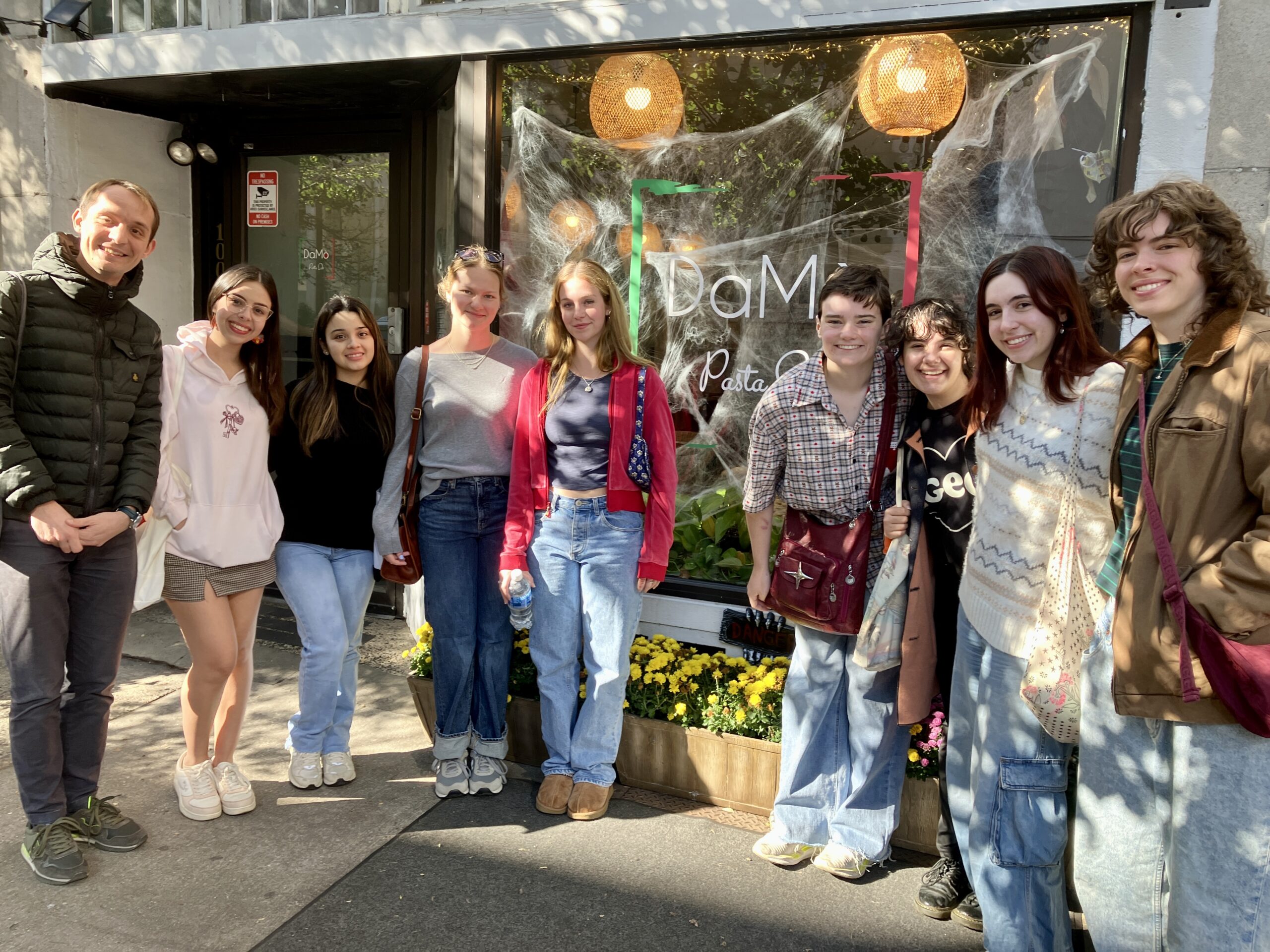
Students in Bryn Mawr’s Intermediate Italian Through Culture I course took their learning off campus on Oct. 26 during a field trip to DaMo Pasta Lab in Center City Philadelphia, a fast-casual Italian restaurant that specializes in fresh, homemade pasta. The group took the SEPTA to Suburban Station and walked to the nearby restaurant.
DaMo Pasta Lab was founded in 2019 by Italian chefs Monica Fenocchio and Danilo D’Eugenio. The restaurant offers dine-in service, pickup and delivery, as well as fresh pasta and sauces for customers to cook at home.
The course is taught by Luca Zipoli, Assistant Professor of Transnational Italian Studies. Zipoli, who joined Bryn Mawr in 2022, described the course as one of his favorites to teach because it changes every semester. “I enjoy tailoring the cultural contents and the class activities according to my students’ interests and passions,” he said. “While teaching Italian books, songs and movies, I get to re-think many aspects of my own culture by looking at it through the eyes of my students.”
During the visit, students participated in a three-course pasta tasting, with each dish representing a different historical period of Italian cuisine. Fenocchio provided the cultural context of each recipe in Italian while D’Eugenio prepared the dishes.

The first course featured lasagna from Emilia Romagna, a region in northern Italy. Fenocchio explained that lasagna was one of the earliest forms of pasta in the Roman Empire and that every region of Italy has its own unique version of the dish.
Next came Cacio e Pepe, a pasta made with pecorino cheese and black pepper. Fenocchio described how the dish dates back to the Middle Ages and noted that the fork was popularized in Rome because of the difficulty of eating spaghetti with a spoon.
The final dish was Gnocchi alla Sorrentina, a potato gnocchi baked in tomato sauce from Sorrento, a town in southwestern Italy. Fenocchio explained that although tomatoes and potatoes were introduced to Italy in the 16th century through the Columbian Exchange, they were not widely adopted in Italian cuisine until around two hundred years later, largely out of necessity during periods of famine.
“I hope that, by tasting the pastas and listening to Monica’s historical explanations, my students took away not only the Italian vocabulary of food but also a deeper understanding of the cross-cultural exchanges that shaped most of the staples of the Italian cuisine,” Zipoli said.
Zipoli believes that field trips are a good way to “expose the students to full-immersive linguistic contexts that can deeply enhance their language proficiency skills.” He chose the restaurant because it is “very similar to an authentic Roman trattoria.”
“I deeply appreciated the fact that Danilo and Monica opened the restaurant earlier only for us, so that we could enjoy the venue before it got busy with incoming customers,” he said. “I also loved how the students interacted with the cooks by always speaking Italian and by practicing all the structures and vocabulary that we had been studying in class.”
Zipoli encouraged students interested in the Italian program to enroll in the introductory course, Beginning Italian I. He described the course as “the gateway to a whole range of exciting opportunities,” including field trips, study abroad and interdisciplinary courses across departments such as Art History, Film Studies and Africana Studies.
DaMo Pasta Lab is open from 11:30 a.m. to 9 p.m. on weekdays and from 12–9 p.m. on weekends.
