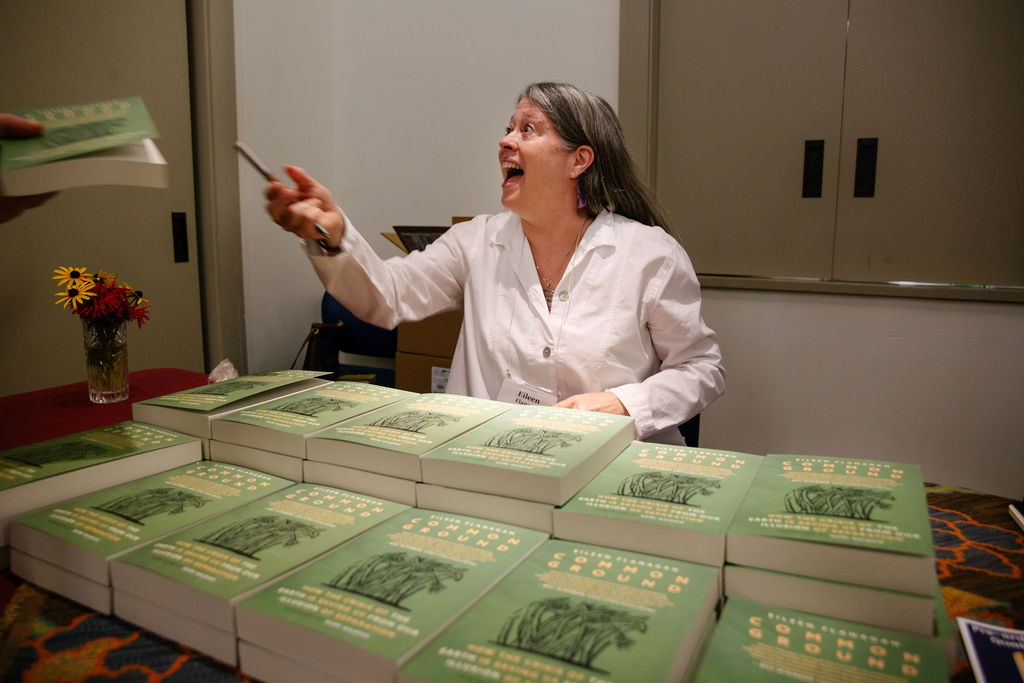
On Monday evening, Tri-Co EQAT members held a virtual watch party for climate activist Eileen Flanagan’s lecture at the local Quaker retreat center, Pendle Hill. Flanagan, a local Earth Quaker Action Team leader, has recently published a book titled Common Ground, which focuses on the importance of building strong coalitions to reap success in the challenging work of grassroots organizing. This was an opportunity for members of Tri-Co EQAT to hear from a veteran EQAT organizer who has worked for decades in the fight against the climate crisis.

Speaking to a good crowd of attendees at Pendle Hill, Flanagan introduced the theme of her lecture ‘Building Common Ground in Polarized Times’— as an argument for embracing the relatedness of all people and natural beings by resisting the “illusion of separation.” She opened by remarking on how systems of oppression have historically sought to divide people and create an illusion of difference between groups, whether that be based on race, age, or political affiliation, for example. In reality, the specific burden of pollution is widely felt yet shared unequally, with a disproportionate amount of the majority lower-class non-white communities bearing the brunt of the problem.
Flanagan continued in her talk by sharing several anecdotes (included in her book) of how different groups have successfully organized across boundaries and built strong coalitions in the face of environmental injustice. Recounting a story of how a native community partnered with local ranchers to stop an oil pipeline from being installed across their land, she highlighted the two groups’ relatedness in their shared concern over the contamination of their drinking water. This was an example of a successful coalition, but Flanagan also emphasized the need to acknowledge failures in activism and learn from them.
Underlining the fact that pollution knows no boundaries, Flanagan shared another story of a community that failed to form a coalition after its white members (who lived on one side of the polluting plant) denied the pollution that was disproportionately affecting its majority Black population, who lived on the other side of the plant. As a result, no coalition formed to resist the polluting facility.
Discussing the importance of building coalitions for climate justice, Flanagan especially emphasized the importance of spiritual grounding in order for a climate activism campaign to find success. In other words, when all members of a cross-group coalition are aligned in values of unconditional love, empathy, and mutual support, their capability to bond together and mount meaningful escalations of action against polluters is significantly stronger.
The talk ended with a concluding protest song of hope for the future, its timeless lyrics proving simple yet incredibly empowering:
In hope and prayer, we find ourselves here
In hope and prayer, we’re right here.”
We rise, we rise, we rise!
