Written and reported by Leilani Davis, Max Johnson, Oliver Lavallee, and Jessica Schott-Rosenfield
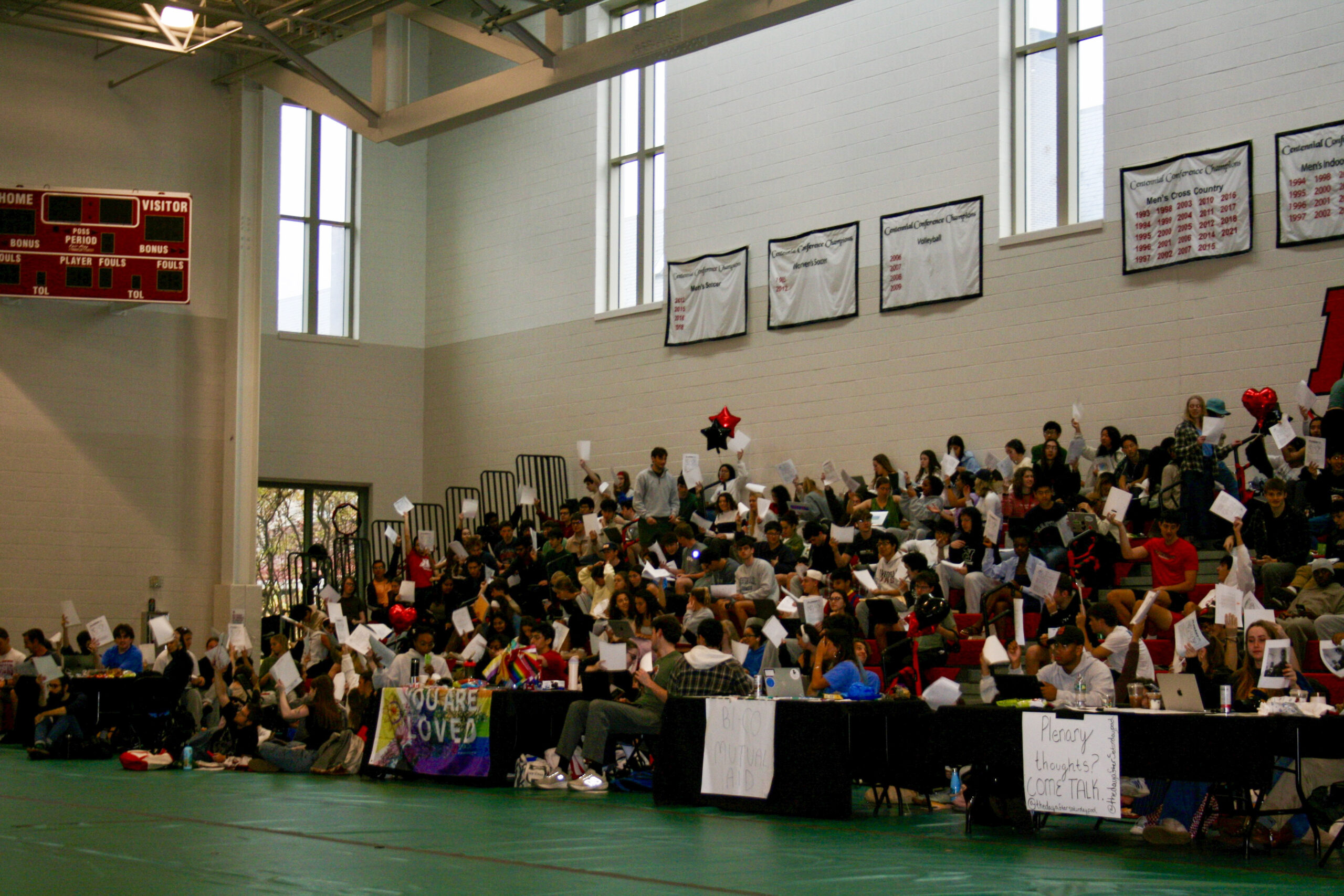
Over the course of a three-hour fall Plenary, the Haverford student body passed all six resolutions brought to the table, putting their support behind a complete restructure and rewrite of the Honor Code. Undertaken by CSCAR (Committee for Student Community, Agency and Responsibility), the rewrite is the culmination of six months of work by 24 writers and countless contributors. Committee Co-Heads Sofie Quirk ’28 and Ben Perez-Flesler ’27 were a part of the presentation for every resolution, alongside rotating groups of contributing writers. In-depth analysis of the dominant changes made to the Code can be found in our pre-Plenary rundown.
Before noon on November 9, students began lining up as usual, for the chance to receive some coveted t-shirts, stickers, and a cornucopia of Swedish snacks offered up to match the Plenary theme: IKEA. The theme aimed to represent the spirit of the Code’s reconstruction, and featured a live furniture-build of two couches which will soon be moved into the Dining Center basement.


As the clock struck 1 PM, students began filing into the GIAC, and at 1:45 PM, dance group “Bounce” treated the community to their traditional pre-Plenary performance. By 2:05 PM, the requisite quorum of 934 students was hit, and Plenary could begin.


Students’ Council Co-Presidents Sarah Weill-Jones ’26 and Benjamin Fligelman ’26 opened Plenary with the State of the Ford. Fligelman noted that because of the Code rewrite, “in all of the years Sarah and I have been at Haverford, this Plenary is particularly notable.” He continued, “Haverford students this semester have engaged in discussions about the Honor Code with gusto. Sarah and I have been heartened as we walk into the Dining Center and hear our peers discussing the State of the Code in passing.”

The Co-Presidents offered an overview of all that has been done in the course of their tenure thus far, citing conversations about party safety with the Haverford Survivors Collective and JSAAPP, the emergency bailout of Bryn Mawr SGA’s by our Co-Treasurers, and new physical campus features like the picnic tables outside Lloyd as highlights.
Weill-Jones added a note about the current political landscape: “We understand now more than ever has been a time disruptive in higher academia to say the least,” they said. “We commend you for continuing to engage in discourse, to show up and be present, even when motivation is low.” They encouraged the community to keep relying on and showing up for one another: “We protect each other, we keep us safe.”


The Rules of Order were then presented, and while waiting for electronic votes from satellite rooms to be counted, Fligelman pronounced, “Today, we passed 1,000 people for quorum, which is amazing and makes my heart sing with joy!” With that, the presentation of the resolutions commenced.
Resolution #1: Constitutional Updates
The first resolution proposed, which amended the Student Constitution, was needed to pass in order for the Honor Code to be amended during fall Plenary. Without this resolution, all subsequent resolutions would need to wait until the spring to be ratified. Alongside this urgent change were several touch-ups to the functioning of Plenary and student government.
Firstly, the Honor Code, Honor Council Charter, and Alcohol Policy would all have a ratification vote at every Plenary. However, a failure to reach quorum or reach a certain number of ratification votes would no longer annul these three integral documents; instead, if votes to ratify without concerns make up less than 80% of submitted votes for either the Code and Charter or Alcohol Policy, a committee will be formed to investigate issues and recommend amendments to these documents, which can be passed as resolutions at plenary with a two-thirds supermajority.
Additionally, Resolution one would make JSAAPP (Joint Student-Administration Alcohol Policy Panel) Co-Heads members of the Students’ Council, no longer require that an international student hold the position of Representative of International Students, and remove the line stating that “it is encouraged that students who self-identify as students of color vote and/or run for the Officer of Multiculturalism.”
In presenting the resolution, Jack Weinstein ‘27 stated that “By ratifying the Code twice a year, with lower stakes, we intend for the student body to have more regular chances to reflect on the Code without the threat of it failing entirely, potentially leaving us without any Honor Code at all.”
After a couple questions about the resolution’s long term effects on Plenary and the necessity of semesterly ratification, presenters Sofie Quirk ‘28 and Ben Perez-Flesler ‘27 argued that the urgent necessity of enabling a new Honor Code to be passed outweighed long-term risks. They also reassured concerned students by saying that the constitution could be amended again at a more stable time.
The resolution passed with strong support.

Resolution #2: Changes to Preamble and Article I
The second resolution sought to implement the newly written preamble and introduction to the Honor Code. Beginning with a quote from past Haverford President Isaac Sharpless, this section articulates the Honor Code’s purpose in the community, and sets the stage for the rest of the document. By explaining the application of the Haverford values of trust, concern and respect, section 1.01 intended to bring meaning back to the sloganized concepts which have, as Sofie Quirk ‘28 put it in her presentation, “become somewhat meaningless.” The resolution ends with a revised commitment statement to the honor code which asks students to “hereby accept… responsibility to the Haverford College Honor Code, and therefore exemplify the collective and personal responsibility upon which it is based.”
Without any questions or pro-con statements shared by students, the resolution was smoothly passed.
Resolution #3: Adopting Article II (Confrontation)
Resolution three proposed a new “confrontation” section of the Code. Co-presenter Abby Lurensky ‘27 stated, “In the past, much of the description around confrontation was repetitive and unclear, with an overly bureaucratic focus on how to confront people, rather than on the value behind it. It made confrontation seem lofty and intimidating, whereas the new Code emphasizes collective engagement and speaks to the way we, as students, aspire to act.”
Central to the discussion of this resolution was a question raised by Claire Reisberg ‘27, who recited a section regarding anti-racism which had been removed from the revised Code. After reading it aloud, she asked whether whether the community would still uphold these values, “even if not written.”


The presenters responded that they never wanted to remove explicit mention of these values, but were limited by federal regulations. Quirk added that language relating to anti-racism and discouraging discrimination are addressed more directly in the Social Code.
The pro/con debate brought up concerns about differentiating confrontation and harm, and the potential for harm in the new Code’s limited description of confrontation. Pros offered appreciation for the revision’s emphasis on necessary discomfort in confrontation. In response, the presenters highlighted the difficulty of an exhaustive list of harms which could be committed, and the hope that individuals would be able to advocate for themselves using the Code as a guide rather than a rigid set of rules.
Resolution three also passed easily, with a clear two-thirds majority.
Resolution #4: Adopting Article III (The Social Code)
Discussion of Resolution four began with junior Radha Ivanova asking how this amended section deals with the potential for students claiming “reverse racism,” in confrontations, using the Charlie’s Angels case abstract as an example of the precedent for these kinds of claims, and taking issue with the amendments’ vagueness and potential for weaponization. Perez-Flesler responded that he read the Charlie’s Angels case and others when trying to figure out how to deal with the issue. Quirk cited a line of the amended code which reads, “Dismissing, disparaging, or silencing an experience of such harm, rather than being open to hearing others’ experiences and working towards mutual understanding and betterment, shows a lack of concern for our fellow community members” to explain how this potential issue was addressed in the Code.


Moving into the pro/con section, several students began to line up to present an argument. Quentin Cooper ‘29 noted that he saw the relative vagueness of the new Code’s language as a pro, and a way of dealing with unintentional harm among community members. Ian Trask ‘28 emphasized the risk of students’ right to form the Honor Code being taken away and having the temporary, redacted Honor Code of May 2025 reinstated if these resolutions do not pass.
Students presenting “cons” were similarly enlivened in the dialogue about the resolution. Madeline Berkowitz ’28 warned of the presence of government censorship in the resolution write up. Senior Will Bender called it a “husk of a social code” and questioned how the power of student government applies when the code had been emptied in this way.
As a response to the debate, presenter Clare Jackson ‘29 noted that, “no matter what we write in the Code, students will act the same way.” Though this statement might have been interpreted as an apathetic nod to the inability of written policy to provide a solution to any entrenched prejudice that might already exist on campus, Jackson’s comment evidently meant to convey that the Code is an ideal vision of community values, but also that its ideals are not dictates which can force students to think in one way or another.
Quirk also warned that if the vote fails, Haverford will go back to the strikethrough code from administration, and Perez-Flesler added in response to concerns over the removal of DEI language that, “the fights you’re asking us to fight are the fights we’ve been fighting for the last six months.”
As students remained in line, the 10 minutes allotted to the pro/con section ran out and students voted not to extend the time. Soon after, the resolution was passed with a two-thirds majority vote.
Juniors Julian Anderson-Rodriguez and Claire Reisberg attempted to pass an unfriendly amendment to the resolution by gathering signatures in the room during the presentation, but failed with just under the required 75 signatures when the time came to present amendments.
Anderson-Rodriguez and Reisberg were frustrated by the removal of language related to DEI in the social code, and wanted to reintroduce it. While they understood that that language would likely not be allowed to remain by President Raymond, they still thought it was important to include it.
“I think there should be this understanding that even if the president vetoes things, and she’s going to veto it, there’s still value in making a collective statement as a student body that, no, we’re not going to stand for this,” said Reisberg.
The two were also concerned about a lack of student awareness and apathy towards Plenary.
“I think the problem is that what promotes apathy is that there’s just not a focus on what is important about this,” said Anderson-Rodriguez. He added that he did not think students were aware of the language that had been taken out of the Code.
The Co-Presidents had no knowledge of the amendment being circulated at the time, nor did the majority of Plenary attendees.
Following Plenary, the News spoke with Dean McKnight about his perspective on the discourse around administration’s role in keeping the Code compliant with legal standards. McKnight said, “I think it’s unfortunate, right, that the, you know, give and take of trying to find language that expresses what the true commitments are that we have as a community, or mainly that students have as a community — that that is in tension with what is considered to be most appropriate in this sort of federal landscape.”
He noted that even before the election of the Trump administration, some elements of the Code were not compliant with federal policy. For instance, the constitutional language changed by resolution one hasn’t been compliant with Civil Rights law for several years; previous sections could easily have been interpreted as advocating for offering greater consideration to people of marginalized identities, which would be a violation of federal standards of equal rights.
McKnight emphasized that ongoing conversation among students and with administration is crucial to the project of lessening the tensions between legal standards and students’ wishes, and that opportunities for changing language will still be available throughout the year.

Resolution #5: Adopting Article IV (The Academic Code)
Resolution five, Adopting Article IV (The Academic Code) of a New Honor Code was presented next. After the presenters read the resolution aloud, two students asked questions. The first inquired about the absence of language regarding respect for professors, to which the presenters replied that this language was more present in the Social Code.
Next, Deven Abrams ‘26 asked why the Code does not acknowledge that cheating, a form of academic dishonesty, is a choice, as the Code does include the circumstances that may make cheating more likely. In response, presenter Mahek Jhaveri ‘27 said that these circumstances encapsulate most instances but are not an exhaustive explanation for cheating.
The issues raised during the Q&A and the pro/con portion were mostly regarding specifics of the language used, with Dan Gordon ’29 concerned that the rules regarding AI usage are too vague.
“I’m a student here,” he said. “I’m confused sometimes by what I can and can’t do with [AI].”
In response, Jonah Patterson ‘26 argued that the Code does effectively address AI usage, emphasizing the importance of student agency. “This code calls upon us to clarify with our professors if we don’t understand what’s going on,” he said, adding that students should not be using vague instructions as an excuse for academic violations.
Despite these concerns, the resolution overwhelmingly passed.
Resolution #6: Adopting Article V (Related Practices, Policies, & Procedures)
The sixth and final resolution passed contained the “Related Practices, Policies, and Procedures of the Honor Code,” as well as the new Honor Council charter.
A concern raised by Abrams was that the restorative justice practices in the new code would not allow for adequate consequences in the event of academic violations. He went on to say that, “We shouldn’t vote on resolutions because we like the spirit of it. We should be fully confident with what we put forward in the academic code.”
Quirk responded to his first concern by emphasizing that Honor Council circles that use restorative justice are not lacking in consequences.
“If you do the work and read our Honor Council charter or look at the abstracts, you will know that this is very much not true,” she said, also saying “Do your homework; let’s talk about restorative justice. It does have consequences, and it’s deeply, deeply impactful to the students who go through it on our Honor Council circles.”
Perez-Fleser added that there were many opportunities for students to give their feedback on the new Code, and that voting down a resolution because of a disagreement with a few words is a useless a statement.
After the resolution had been passed, Abrams told the Bi-Co News that “I stand by what I’ve said, that I don’t think we should be voting for things based on their intentions. I think we should vote based on what the resolution actually says. And so for that reason, I felt the need to vote no on certain resolutions.”
Abrams felt strongly that student engagement in conversations about the Code is crucial to getting more explicit guidelines solidified. “The less people we have blindly voting on resolutions, the better,” he said. Ultimately, he voted for the ratification of the Code, since he felt it was overall a good revision.
Opening Ratification of the Honor Code and Alcohol Policy
Honor Council Co-Chairs Sofie Quirk ’28 and Michael Pyo ’26 came forward next to give a speech on the importance of the Honor Code and its main tenets. Pyo closed with a call for reflection: “As you leave Plenary, we urge you to move forward with a newfound sense of commitment and obligation to the Honor Code, whether it is on your next exam or the next conversation you have with a friend.”

With no questions, pros, or cons raised, the Honor Code was officially opened for ratification.
Finally, the JSAAPP (Joint Student Administration Alcohol Policy Panel) Co-Heads, Jackson Cannon ’28 and Isabela Azumatan ’27 came up to present a brief overview of the policy. Again, no questions, pros, or cons were offered, the policy was easily opened for ratification, and with that, Plenary concluded.
Post-Game Reflections
Following the event, Quirk told the Bi-Co News, “I am incredibly grateful to the students of Haverford for showing up today and lending their voice to this process. CSCAR does not end here, nor did it begin at the beginning of the semester. It is an ongoing effort to revitalize our community values and stand for what they mean to us on an individual and collective scale, and I think today was a really good show of that. There’s more work to be done, as always, but I can’t wait to see the ways in which people take their comments from today and transform that into action activism over the course of the rest of the year and over the course of the rest of their time at Haverford.”
Students’ Council Co-President Sarah Weill-Jones ’26 was equally thrilled: “I’m extremely happy with how it went. I’m really glad that students actively engaged with parts of the code that they agreed with and didn’t agree with because that’s the whole point of Plenary—to have meaningful discourse.”
Co-President Ben Fligelman ’26 agreed thoroughly. “I’m overjoyed,” he said. “I’m over the moon. I’m so glad that we got quorum. At some points we had over a thousand students participating in Plenary.” He added, “I specifically want to shout out to everyone on Student’s Council who worked so hard to make this happen… A good council is a good team, and I think that we’re a great team. I think we were able to do amazing stuff.”
Dean McKnight, present throughout the Plenary proceedings, told the News, “I’m just really proud of the student leaders … from CSCAR, to especially Sofie and Ben who did the lion’s share of the presenting today – but also the students who showed up and engaged thoughtfully with really good questions,” adding that he’s looking forward to continuing conversations about the Social Code throughout the year.
Correction: A previous version of this article stated that Deven Abrams ’26 had voted for the ratification of the Code “in its entirety.” This is inaccurate; though Abrams voted to open ratification of the Code, he ultimately voted during the period of online voting which follows Plenary with objections to the specific concerns he had raised. The Bi-College News apologizes for this error.


3 comments
What I find incredibly sad in reading about the plenary debates related to the inclusion of language highlighting the needs of minority students—at least as reflected in this article-is that each minority student, each student, is a precious individual with their very unique story. Each person is a precious and unique individual.
Being in community with each ought to mean honoring and giving space for every story. Challenging gently those we disagree with and learning from each other. In community, one should approach each other without assumptions, interested in unique individual stories.
The College is responsible for teaching sociology, history, politics, psychology, literature, government etc. in away that broaden students’ sensitivity and understanding. And then students should be in dialogue with each other about what they learn, and they should be open to learn if they inadvertently cause pain.
One cannot legislate away racist, misogynist, transphobic dynamics by trying to control speech.
Who is to say what human experiences are the most painful. Is a fellow minority student from a comfortable upper class background more vulnerable than someone who grew up with an addicted parent and no security of having food on the table? than an incest survivor. We were not put on this planet to judge each other.
Hold on dearly to the idea of mutual respect and free speech and learn from the light within all of us.
Excellent piece; congratulations to the authors.
Congratulations to all who participated. After decades of mourning the effective loss of the Honor Code that I found so character-forming during 1967-71, I’m heartened that so many students seem to have renewed interest in the general problem of living in a community that seeks to maximize liberty of thought and action, where mutual respect is predictably demonstrated in actions that may demand uncomfortable increases in maturity and self-knowledge.
The attendance and engagement at the plenary was a good sign, I think. When a community acts in concert, there’s hope, regardless of whether it should have done something else. Thanks for the hope, folks.
Thank you Steve!