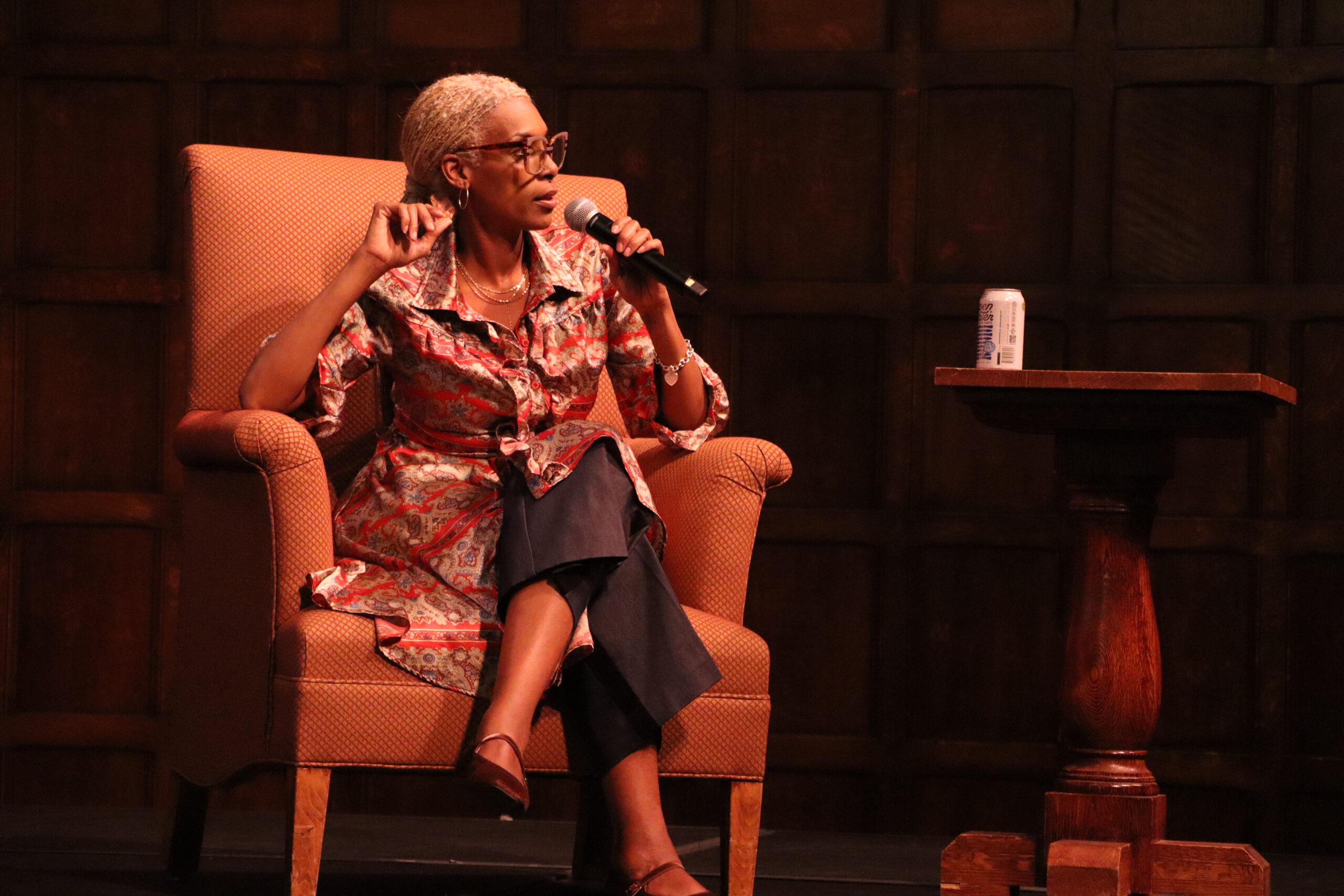
As Black History Month came to an end, social justice advocate and political strategist Kenyette Tisha Barnes was invited to give a keynote address in the Great Hall, closing out a month of programming by discussing the the action of survival as a method of rebellion and the path towards change. The closing address was titled “Survival IS the Protest: A Lordeian Framework of Surviving Under Ongoing Oppression”.
The statement began with opening remarks from Tomiko Jenkins, Bryn Mawr’s Interim Dean of the Undergraduate College, and Chinyere Udokporo, the Assistant Director of Intercultural Engagement. Then, Adara Alexander ‘27 introduced Kenyette Tisha Barnes, citing her multitude of roles including her title as a “Legislative Empress”, whose work against sexual violence and for social justice brought her into legislative and lobbying work in Georgia, Detroit, Chicago, and Philadelphia.
Barnes began the speech addressing her professional work, but acknowledging that as she stood on the stage, “Tonight, I am just speaking as a human.” She reflected on her activist journey, starting in the darkest moment of her life in a Chicago park, where this speech was first drafted. Her inspiration came from Audre Lorde, a Black, queer writer whose work “Litany for Survival” constructed the conceptual framework for Barnes’ argument. Lorde, who is referenced in the speech’s subtitle, describes survival as a ‘tactic of revolution’, which Barnes refers to frequently as she defines healing and self-protection as the foundation for individual activism.
Barnes then brings up her work against sexual violence, including her part in the #MuteRKelly movement. Founded by Barnes and Oronike Odeleye in 2017, the movement aimed to draw attention to pedophilia and abuse accusations R Kelly faced throughout his career. She reflects on some of her experiences, including following the artist to a small, suburban venue after the movement got him ousted from a larger venue, only to get his performance cancelled there, as well. Barnes reminds audience members that “We survive- but survival comes at a cost”.
Barnes address also reminds listeners that “Every day you wake up in a world not designed for you, that is protest. Every time you refuse to disappear, that is the most radical protest of them all.” She compares the process of transformation to that of a butterfly, where the process inside of the chrysalis requires dissolving and ‘unbecoming’ before turning into something new. Barnes also brings up “double consciousness”, a term coined by W.E.B. Dubois that characterizes the psychological conflict African Americans face while navigating a society that often devalues them. She leaned into a powerful string of acknowledgements to the crowd, quoting after each, “You survived.” Afterwards, Barnes remarks, “It was the refusal to disappear, to be discarded, even when disappearing would be so much easier.”
Moving forward, Barnes talked about what comes after survival, defining it as just the beginning. She says “And when the clouds of doubt catch you off your guard, remember who you are”, and encourages ‘revolution’ as the building after survival. She ends her remarks with “and when we speak we are afraid, our words will not be heard, nor welcomed, but when we are silent, we are still afraid. So it is better to speak, remembering, we were never meant to survive”- the direct ending from Lorde’s original work.
The address then transitioned to a dialogue with two organizers of Black History Month programming. The dialogue was introduced by Candice Love, the Director of the Impact Center, and conducted by Gaelle Isophe ‘26 and Kaili Martinez-Beasley ’27. The hosts asked questions about legislative action, to which Barnes reminds us that before legislative work can be pursued, we first must take care of ourselves. She acknowledges that it takes professionals and experience to understand how a system works so that it can be dismantled, but that this work isn’t possible without a team of individuals who are ready to take it on.

Barnes also brings up her long history of advocacy for the HIV crisis, particularly as it affects queer individuals and black communities. She emphasizes the language used in the crisis, reminding that is isn’t fear, but “bigotry” that leads to “punitive legislation” and ineffective response efforts. Finally, Barnes is prompted to talk about responding to media and public scrutiny. She references the pressure placed on her to tone down her work, including imposter social media accounts that pretend to announce a mutual agreement regarding her work with #MuteRKelly. She brings up that direct action is “not therapy”, and to do wide scale protest, an individual should be aware of what they are signing up for.
The mic is then opened to the audience, moderated by A.T. Ortíz, Dean for Equity, Inclusion, & Community Life. Barnes was prompted to discuss maintaining humanity in survival, where she acknowledged that to face a system that was “made to break” marginalized individuals, they can only push through. Additionally, she was asked about reconstructing versus abolishing legislation as a means of change. Barnes brought back the discussion of longevity, where abolishing often has short-term benefits but long-term costs. She contended a balance between both that is achievable through contemplation, but how both have their places. Finally, Barnes was asked to address activism in the current political atmosphere, where she said “I can tell you what you probably should do: when you’re dealing with obvious malevolence, attempting to deal with it as if it isn’t malevolence: not only is it foolish, it is political suicide.” She expressed hope with 2026 midterm and general elections, and encouraged recognizing obstacles and mobilizing support as they rapidly approach. She reminded listeners that “Systemic malevolence cannot stand on its own, and at some point it becomes cannibalistic.”
Kenyette Tisha Barnes is a political strategist and social justice advocate known for her legislative work in Georgia fighting against sexual violence, human trafficking, stigma around post-partum depression, pushback on special education, and barriers to voters’ rights. She can be found on Instagram and information on her keynote address can be found on the Bryn Mawr website.
This year, the national Black History Month theme was “A Century of Black History Month Commemorations.” Events have included the Black Excellency Panel, the Unsung Heroes reception, teach-ins and a Decades Dance. Programming was organized by a panel of student organizers, who were recognized at the conclusion of this event.
