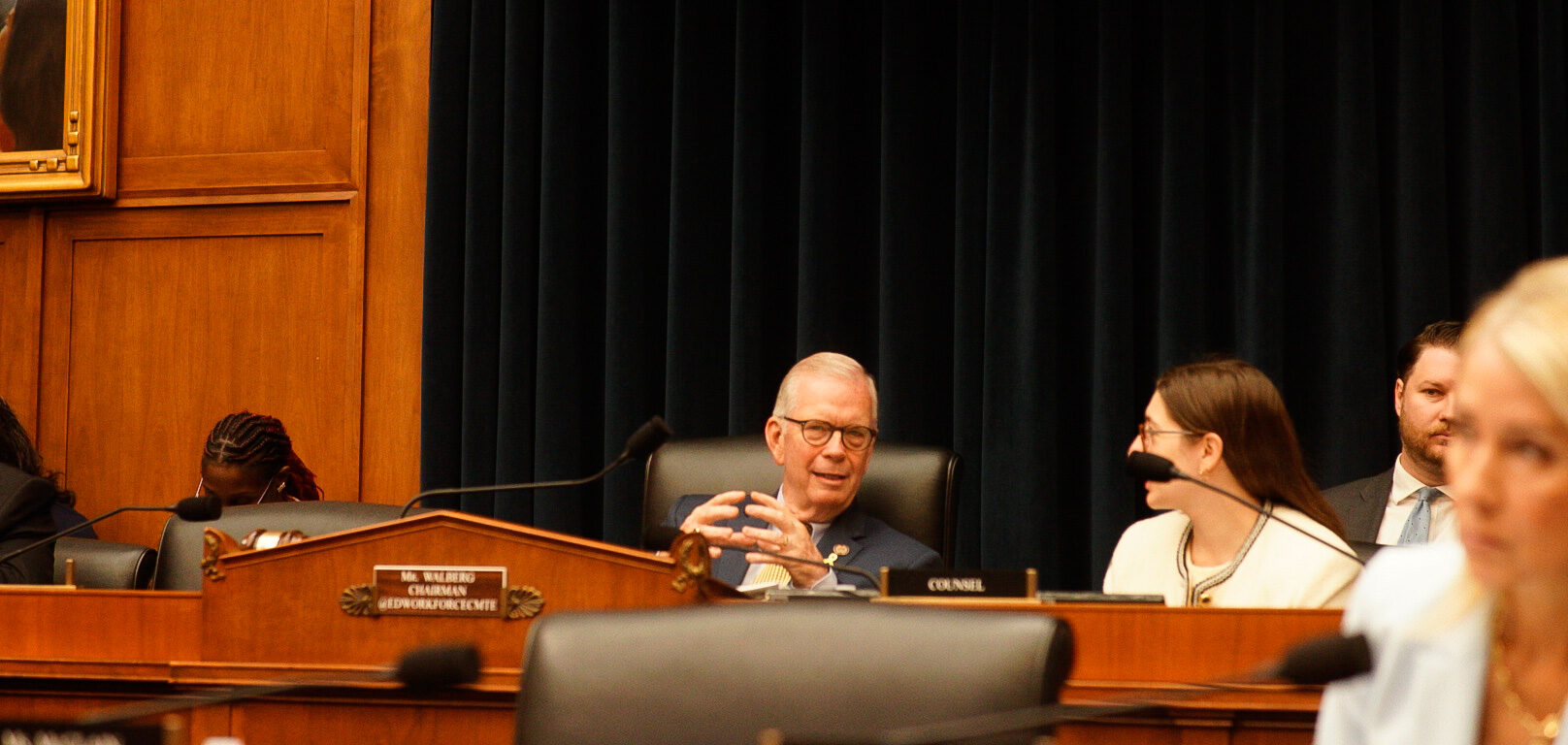
Nearly two months after grilling Haverford president Wendy Raymond at a hearing called by the Committee on Education and the Workforce, Chairman Tim Walberg (R-MI) sent a letter to Raymond requesting further information and documentation regarding events and discourse at the college following October 7, 2023.
The committee is requesting this information pertaining to five main points of interest raised at the hearing on May 7: disciplinary processes for students accused of antisemitic acts, investigations into faculty members’ similar rhetoric, statements made on social media by Bi-Co FSJP (Faculty and Staff for Justice in Palestine), and the “Federal Donuts” incident. Similar letters were sent to the presidents of DePaul University and California Polytechnic University (San Luis Obispo) who were questioned alongside Raymond.
President Raymond was a particular target at the hearing among her peers, receiving arguably the harshest lines of questioning. The committee’s reasoning for this scrutiny was Raymond’s refusal to provide hard data regarding the number and names of students disciplined in response to accusations of antisemitism, and her refusal to provide the details of investigations into faculty members who posted controversial statements on their social media accounts. When asked for these details, Raymond repeatedly asserted that it is College policy not to reveal this kind of information; her response proved inflammatory, Rep. Ryan Mackenzie (R-PA) declaring that such a lack of transparency might put the partnership between Haverford and the federal government “in jeopardy.”
Following the hearing, several community members, in casual conversation, voiced confusion — to what policy was Raymond referring? The committee had the same question; their letter asked when the college first adopted “this policy or position” and further asked for “a copy of the Haverford policies underlying your refusal to publicize or publicly discuss these numbers, whether individually or in the aggregate.”
Jesse Lytle, Vice President and Chief of Staff of the College, acknowledged that it might have been more accurate to say that it is Haverford’s practice rather than written policy not to publicize the numbers. In any case, the College is trying to balance cooperation with the committee, and protecting students’ information. On the topic of the initial hearing, Lytle noted that though the process has been a drain on the college’s finances — insurance covers only some funding for litigation — and time, “you can’t get jaded by the political process and forget what you’re working towards” — that is, a community free of antisemitism.
Lytle and another college spokesperson affirmed that Haverford answered the committee’s requests by the given deadline, July 10, and “look forward to underscoring that antisemitism has no place at Haverford.” Asked how the college interpreted the committee’s requests for “all documents and communications from October 7, 2023” along with records of disciplinary procedures undertaken for any student infractions, Lytle said that for his part, he’d sent copies of many pertinent email communications, but that the College’ lawyer are still negotiating what amount of student information needs to be shared.
