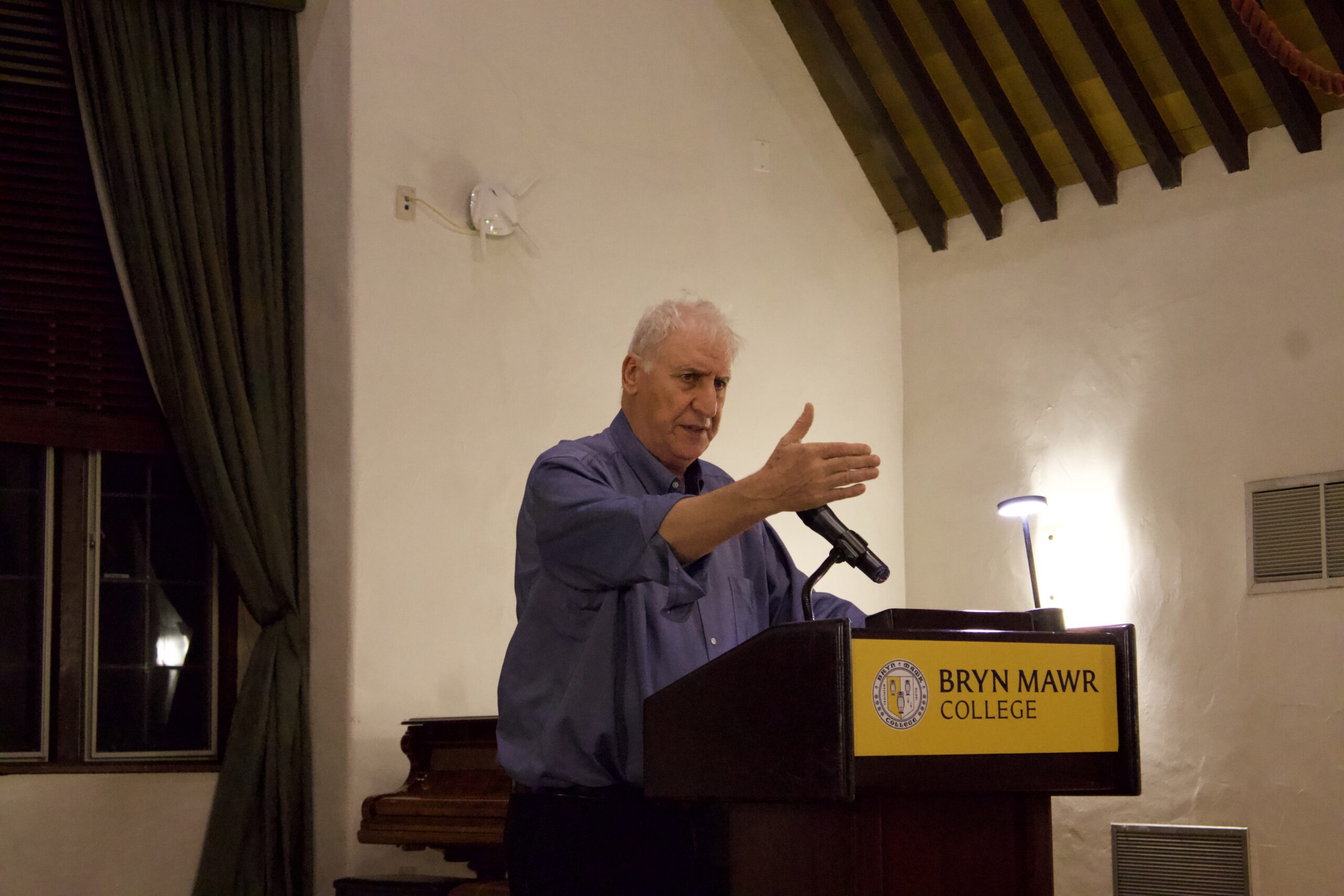
Both young and old filtered into the Goodhart Hall Music Room, their anticipation accompanied by music, including the song “Little Boxes” by Malvina Reynolds. Hugs and niceties were exchanged among many audience members, lending the room a warm atmosphere on one of the first autumn evenings of the year.
On Wednesday, Oct. 8, I attended a poetry reading and discussion by esteemed poet and MacArthur fellow Edward Hirsch, as part of the Bryn Mawr College Creative Writing Program’s reading series. Hirsch’s reading was the first of the 2025-26 academic year. This year marks the 40th anniversary of the Creative Writing program’s reading series. Hirsch was welcomed to the podium with a thoughtful introduction by Professor Dee Matthews, Associate Professor of Creative Writing and co-director of the Creative Writing Program at Bryn Mawr College.
Hirsch prefaced his reading with a clarification: he dislikes Malvina Reynolds’ “Little Boxes,” a satire on the monotony and conformity of suburbia. As a boy growing up in Skokie, Illinois, he knew firsthand that while the houses may have looked the same, the families inhabiting them were all “weirdos trying to fit in,” and they lived the opposite of the “cookie-cutter lives” that Reynolds’ song described. As Hirsch affectionately recounted tales of his “quirky mother, his two fathers, his siblings, and his extended Jewish family,” it became clear that his household was no exception.

During this hour-long reading, Hirsch balanced dialogue and poetry, grief and humor, to give the audience a window into his life. The poems Hirsch read were both linguistically accessible and laden with vivid imagery; the most resonant of these were his poems of mourning.
He read an excerpt from his 80-page elegy to his late son Gabriel, detailing his wildness, his rebellion, and his brightness. “He was trouble / But he was our trouble” Hirsch recited. Grief is often portrayed as being solitary and brooding, something that should be sealed away and endured in silence after the appropriate services have come to a close. While grief can be solitary in the sense that everyone experiences it differently, in whatever form grief takes, it should not be kept to oneself. Hearing Hirsch’s poetry shattered the notion that grief should be silent— it felt like a conversation.

President of the Guggenheim Foundation and long-time educator, Hirsch offered not only poetry of his own, but his mental compendium of poets and their work through history. Leaving us with morsels of wisdom from the greatest thinkers and creatives of history, Hirsch indulged the audience’s readers, writers, and listeners alike.
The night was punctuated with a brief Q&A session, during which Hirsch was asked to give us a phrase that he lives by. He offered two, the first of which was “You have to kiss some strange asses.” This advice, passed down from his father, is hard to argue with. Hirsch joked, “I spent much of my life as an academic; he had no idea how strange.” On a more serious note, he posited, “Attentiveness is the natural prayer of the soul.”
One of my favorite lines that Hirsch read that night was from his poem “My Friends Don’t Get Buried,” in which he says, “I am a delinquent mourner / stepping on pinecones, forgetting to pray.” Yet, what is poetry if not attentiveness—the natural prayer of the soul?
Bi-College students are highly encouraged to attend these readings, like Hirsch’s, all of which are advertised in Bryn Mawr College’s website events section. For interested community members, Nicole Dennis-Benn will be presenting Bryn Mawr College’s next reading session on Wednesday, Oct. 22.
