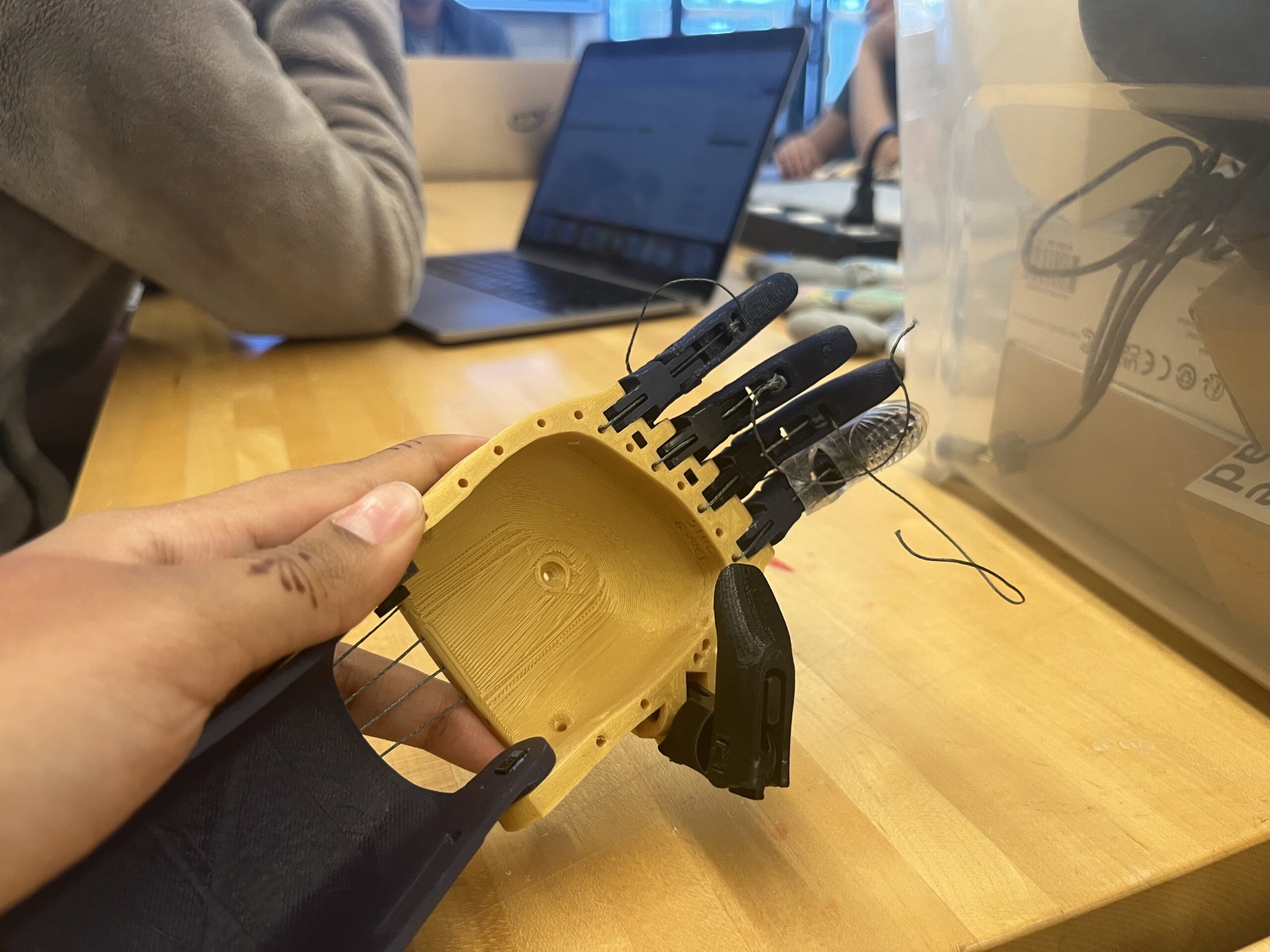
The Innovative Alliance for Sustainable Outreach (IASO) is a new Bi-Co initiative dedicated to creating assistive devices for local clinics and hospitals. Co-founded by Bryn Mawr sophomores Liza Roseman and Jayani Mamidi, IASO aims to address the gap between the availability of assistive devices and the barriers that prevent individuals from accessing them. IASO’s other staff members include Roshni Srikant ’28, Ella Kennedy ’28, Raina Teter ’28 and Nirvaa Shah ’27.
“One of the big things when it comes to disability aids is the cost barrier,” Roseman said. “The price of manufacturing is usually not that high, but there’s also the fact that a lot of times there’s just physically not enough stock.”
Roseman and Mamidi were inspired by e-NABLE, a global database that connects individuals who request prosthetics with verified volunteers who 3D print and deliver them. Using 3D printers at Bryn Mawr’s Makerspace and the Haverford Maker Arts Space, IASO prints, crafts and assembles tools such as wheelchair brake extenders and prosthetic limbs. IASO also reaches out to clinics and hospitals directly to identify the devices that are most needed.

Roseman, who has experience working in clinics, explained that even basic assistive devices can be prohibitively expensive. She used the example of a universal cuff, a device that fits around the hand and includes a pocket or loop to secure the handle of an object: “Even something as simple as that can be twenty dollars, which is a major barrier when you’re already struggling with disability and medical issues,” she said.
“A lot of older folks don’t actually know how to order things online, and that’s the only place you can get a lot of these tools if the tools are available,” Roseman added. “If we’re able to deliver them in person to these clinics, and the clinics can hand them out or deliver them by mail, it gets rid of that barrier.”
IASO’s funding comes primarily from grants. The program also receives funding from a collaboration between Bryn Mawr’s Pediatric Wonders, Haverford’s Women in STEM and the Haverford Maker Arts Space. Roseman hopes clinics will help fund materials once partnerships are established.
“Things like wheelchairs and walkers, which are really common and really necessary, tend to break a lot, or pieces go missing. We can fix a piece for far cheaper than the thousands of dollars it would take to either replace or get it officially done,” Roseman said.
Mamidi emphasized that IASO welcomes students with a wide range of interests: “We’d love to see students from every walk of life come in and join. Maybe they’re not interested in making the devices, but they might want to help with the financial aspect, outreach or social media.”
“The college itself is an institution; an institution is a business model. It’s the students that make this college campus progressive,” Roseman said. “In order to continue making progress, students themselves have to work together.”

One of IASO’s long-term goals is to expand internationally in order to serve as many people as possible. “A lot of these prosthetics are for children, and children grow out of things,” Mamidi said. “An actual prosthetic can cost $75,000, and most of that isn’t covered by insurance. Think about your favorite t-shirt — how many times have you outgrown that? To keep on buying those, it would cost so much for people.”
IASO hopes to collaborate with Bryn Mawr’s new Disability, Unity and Innovation Center to address accessibility issues on campus and beyond. The members reached out to a number of on-campus organizations to gauge interest, including Bryn Mawr’s Accessibility Leadership Committee, Students for Disability Justice Committee and the Career and Civic Engagement Center.
“Increasing accessibility in a community is not just something that falls on the shoulders of people who are affected by it,” Teter said. “It requires a wide net of care and effort across and accessible to the community.”
Teter witnessed the challenges of increasing accessibility firsthand while working in an emergency room in rural New Jersey, where many people work in manual labor jobs such as production and manufacturing.
“A common chronic illness that we saw was diabetes, and a very common complication of having diabetes is wounds and ulcers on limbs,” Tater said. “By the time these individuals could actually even afford to come to the ER, we’d have to send them off to get amputations. Now you have people who are already struggling, and they can’t afford the assistive devices they need.”
“With disability and accessibility issues, it’s not just one issue at one point in time that exists,” she added. “A lot of time, these things are compounding, and they’re affecting people more and more in different ways and across different facets of their life.”
IASO will hold open hours at both the Maker Arts Space and Bryn Mawr’s Makerspace, where students can print and assemble items under supervision. The members also plan to host a workshop at the Haverford Maker Arts Space in collaboration with Pediatric Wonders and Haverford’s Women in STEM.
Students can follow IASO’s Instagram page at @bmc.iaso for updates and sign up to volunteer through the interest form linked on their bio. IASO is currently seeking volunteers to assist with 3D printing, assembly, quality assurance, newsletter writing and publicity.
