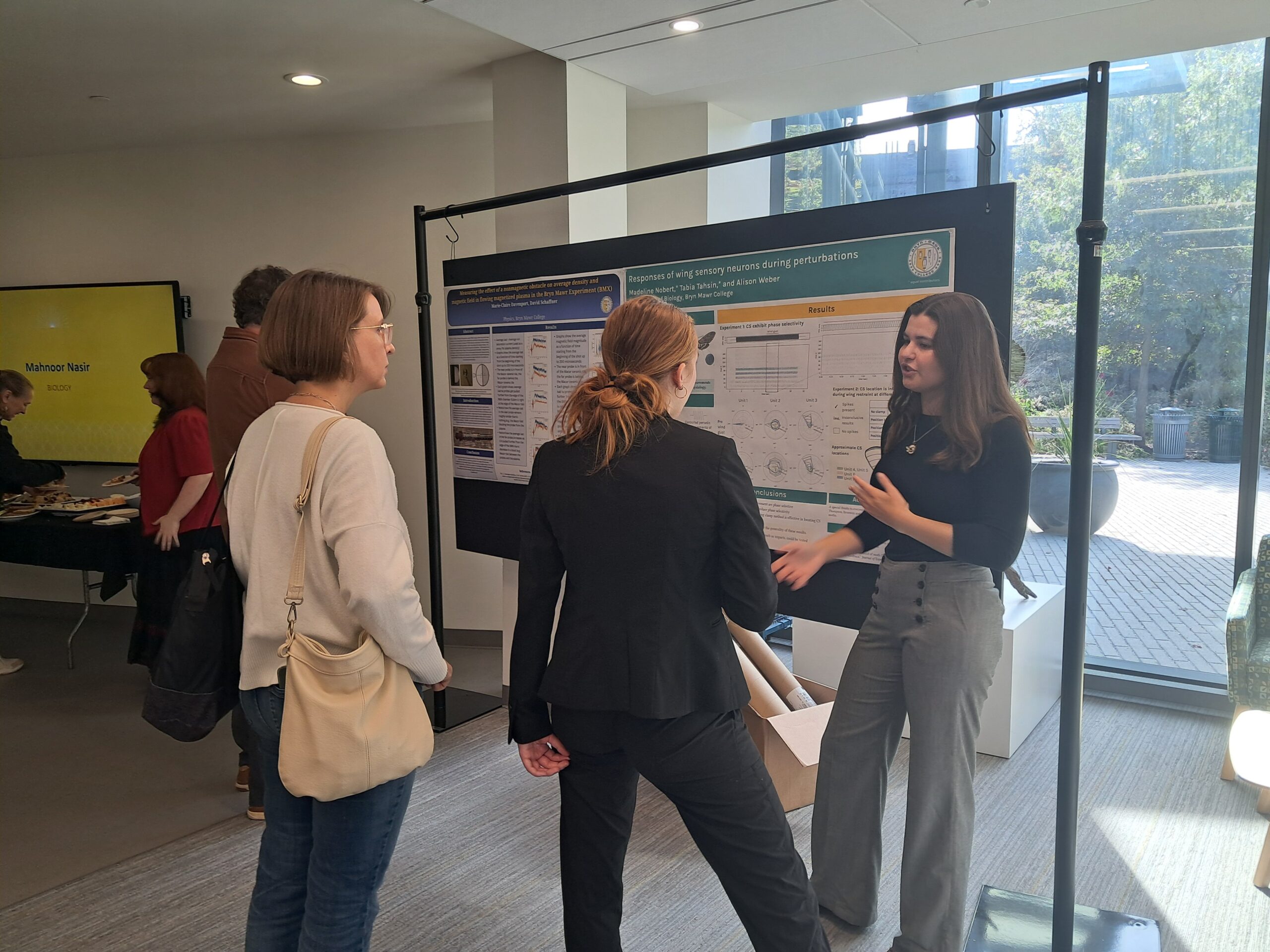
Bryn Mawr professor of biology Alison Weber recently received a grant of just over $400,000 from the National Science Foundation to study sensory processing in flight systems in insects. The grant will allow Weber and the six undergraduate students working in the lab to continue studying the mechanics behind insect flight.
Weber’s lab studies hawk moths and seeks to understand how they receive sensory information from their wings during flight. Hawk moths have relatively few neurons in their wings compared to regions of similar area on humans, leading to questions about how they receive enough information to fly well, said Weber. This study is done through tests that measure electrical signals in the brain when their wings are bent, high speed video recording of the moths in flight in order to study their behavior, and computational analysis of the wing movement. The grant funds these three areas of study.

By looking at which neurons respond to specific sensory input, researchers can better understand how insects have evolved to have such efficient sensory systems that can allow for complex behaviors such as flying while using relatively little processing power. This can be used to create more effective sensors that efficiently collect information. In the past, Weber has collaborated with engineers who used her research to build such sensors.
While the grant will be continuing work that was already being done by Weber and the students working in the lab, the new projects will be the first coming out of the lab as most previous work was setting up equipment. The projects being done as a result of the grant are also more focused, said Weber.
In the day to day, the experiments are run by the students. The students are from a variety of years and have different majors, such as neuroscience and biology. Weber said she is also interested in having a computer science major in the lab as there is a large component of the research that is computer based.

Weber’s interest in neuroscience first began during her own undergraduate studies. After reaching out to a number of labs, she got a position in one that studied touch in humans and nonhuman primates. She quickly became interested in the topic and research questions, she said, and she enjoyed the day to day experience of running experiments.
Amid federal cuts to research, there is a level of uncertainty for all researchers. This was felt acutely by Weber in the process of getting the grant. The announcement of the grant was significantly delayed, said Weber. The proposal had been written with the expectation of starting in April, but Weber was not notified that she had even received the grant until July. While the process of getting a grant tends to be long, it was unusually so for this project, said Weber. Additionally, the budget was reduced without explicit reason.
Despite that uncertainty, Weber hopes to continue researching this topic in the future. She is open to the idea that the field may shift to focus on other topics by the time this project is complete, and she also has other projects that have yet to be funded. However, she expects that there will still be much to explore about this topic.
“In almost every research project,” she said, “by the end of it you have more answers than questions.”
