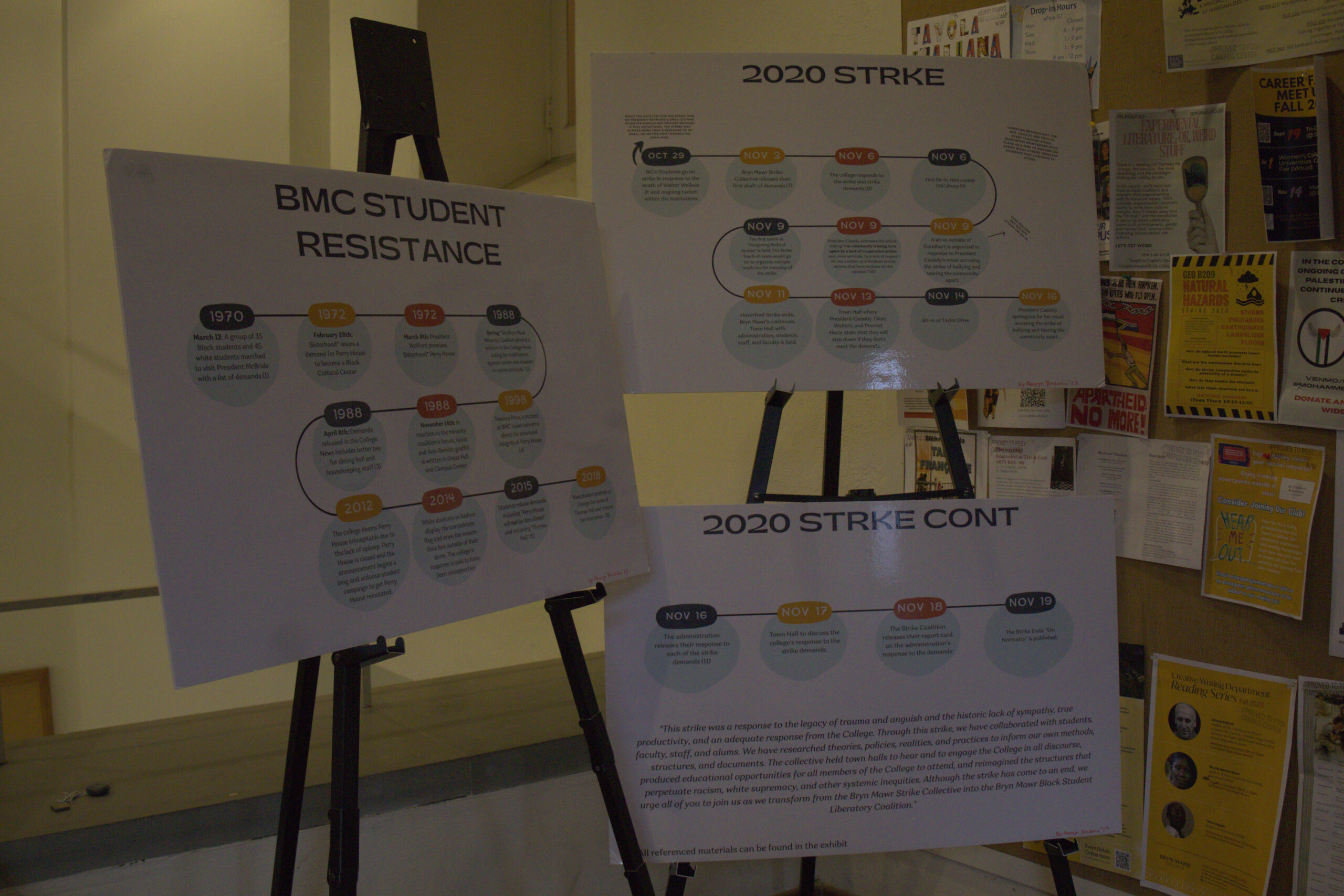
In November 2020, Bryn Mawr students boycotted classes and college activities for two weeks alongside students at Haverford. Five years after the 2020 strike, Bryn Mawr students are determined not to forget its influence.
The strike was in response to the Haverford administration discouraging students to go into Philadelphia to protest the killing of Walter Wallace Jr. by Philadelphia police, which had occurred a few weeks prior. The week of programming was spearheaded by 2025-26 SGA President Eseniá Bañuelos, who coordinated teach-ins with professors, students, and alums to educate the next generation on the work of 2020. Though Haverford students were not directly involved in Strike Week due to the then-ongoing restructuring of their Honor Code, many attended Strike Week events and were left, as Haverford StuCo co-president Sarah Weill-Jones HC ‘26 puts it, “inspired”. While half a decade has elapsed since the 2020 strike, Bryn Mawr students showed up in force to commemorate the actions of the strikers, which continue to have an impact on campus to this day.
Strike Remembrance Week kicked off on Sunday November 9, with SGA President Esénia Bañuelos ‘26 addressing the reasoning for hosting Strike Week as well as what the week would entail. The 2020 Bryn Mawr Strike laid the foundation for various aspects of student life on campus, including the Black at Bryn Mawr requirement for first-year Thrive classes, the creation of the Student Assistance Fund available to students in case of emergencies on campus, and the Power, Inequity, and Justice (PIJ) graduation requirement, among other changes. As highlighted in Bañuelos’ presentation, the initial strike in 2020 proposed 61 demands, 5 of which have since been fulfilled by the administration. The initial strike at Bryn Mawr was inspired by Haverford’s 2020 Strike. Haverford declined promotion of this event due to scheduling conflicts. As outlined in their Haverford College 2020 Strike Statement and Demands, the initial strikes at Haverford were inspired by an email from President Wendy Raymond asking students to refrain from joining protests, which they saw as “a continuation of a long tradition of anti-Blackness and the erasure of marginalized voices…at Haverford”. The strikes at Haverford and Bryn Mawr both consisted of students boycotting classes, on-campus jobs, and school-sponsored activities.
Another opening speech was given by Keyla Benitez ‘24, a student organizer who participated in the 2020 Strike. On the night of Monday, November 10, Benitez began with an overview of the timeline of how the strike began, handing out a zine with photographs from and relating to the strike as well as excerpts from strike documents. Benitez then recounted that in the summer of 2020, amid the Covid-19 pandemic and the Black Lives Matter protests, 10 anonymous students wrote up a list of 14 demands regarding Bryn Mawr College’s attitude toward BIPOC (Black, Indigenous, People of Color) students. The College did not make any significant efforts to address these demands before the school year started and, following Haverford President Wendy Raymond’s email request for students not to go into Philadelphia to protest the recent killing of Walter Wallace Jr. Benitez recounted that over 700 Bi-Co students gathered on Founder’s Green, playing loud music and staying overnight before marching through the streets of Ardmore the following night. While Bryn Mawr students were at first hesitant to join the strike, which originated at Haverford, Bryn Mawr soon formed its own anonymous Strike Collective, which included members of the organizations Zami+, Mujeres*, Mawrters for Immigrant Justice (MIJ), Sisterhood* and Bryn Mawr African and Caribbean students Organization (BACaSO). Benitez remembered a sense of “hope in the air that things would get better” in the early days of the strike. Towards the end of the address, Benitez pointed audience members toward the lack of quotes from BIPOC Bryn Mawr alums on the back wall of Campus Center, which were recently painted over as part of the ongoing campus renovations. Benitez emphasized the importance of student history and institutional memory, leaving the audience with those sentiments as the talk opened up to student comment.
Dr. Lopez Oro, who is involved in Latino/a Studies, Gender and Sexuality Studies, and Africana Studies, held a teach-in titled “Teach-ins as Political Power” on Tuesday, November 11. The teach-in discussed the history of how the fields of Black and Africana Studies were created through the perseverance of black students at other colleges, as well as reflecting on how Bryn Mawr has approached these studies in the students’ education. Africana Studies at Bryn Mawr College had been established in 1969-1970, however it is still currently labelled as a minor- not a major. Noticing that fact as well as being the first full-time Africana Studies professor, Dr. Lopez Oro invited student in attendance to reflect on what it means to have a liberal arts education and how Black and Africana Studies helps to shape that. Students across several colleges have been pushing for years to have Black Studies be established as a major. Lopez Oro highlights how Swarthmore College “has had a thriving black studies program for a number of decades” as “Black students on campus did the same thing that the 2020 strike did- which is break the rules-”. Lopez Oro points out how as a Seven Sister school, Bryn Mawr College does have a lot rooted in its privilege and elitism. However, he also highlighted how the Seven Sisters have been created to provide higher education to women, and how that breaks the “normative structures of violence” that other predominately white institutions practice- similar to the existence of Black Studies. “The radical fact [is] that these institutions [The Seven Sisters] were created to provide women and women-identified folks higher education,” says Lopez Oro. “We have to reckon with the fact that we are at a predominately white women institution that has not poured into Africana Studies in the same ways that it should’ve.” Students at Bryn Mawr have continued to push for a Black studies department to be established. Now, this change is currently a plenary resolution to be voted upon this semester. “There’s an actual commitment [from Bryn Mawr] to not expand it [Africana/Black Studies]’” says Dr. Lopez Oro. “You won’t see any change in any institution unless you break the rules.”


On Wednesday November 12, Bryn Mawr alum Tonja Robinson ‘15 and Valencia Ngunjiri ‘26 spoke on the history and legacy of Perry House as an affinity space on campus for Black and Latinx students, and the Perry House Oral History Project that has been formed in its memory. Perry House, once located beyond Arnecliffe, was affinity housing for Black and Latinx students, until it began to be used as a gathering space for multicultural organizations such as Sisterhood*, BACaSO and later Mujeres*. Perry House was purchased in 1963 from Henry and Susan Perry. Throughout the 1960s, when Black students began enrolling at Bryn Mawr, they were housed in then “Spanish House”, the Spanish language residence. In 1970, after concerns were raised about diminished Black visibility on campus, “Spanish House” was renamed to Perry House, among other demands about curriculum and faculty appointments. The space was turned offline in 2012 and demolished in 2015. At the beginning of Robinson’s time as an undergraduate at Bryn Mawr, Perry House was already in a state of disrepair, with many rooms unusable after years of neglect. After the house was turned offline in Spring 2012, student groups that relied on Perry House as a meeting place protested the school’s neglect for designated affinity spaces. Robinson expressed disappointment for both the neglect by administration to recognize the importance of a space like Perry House, and their peers’ initial dismissal of their concerns. Today, the Oral Histories of Perry House is a record of interviews with students and staff at Bryn Mawr, seeking to preserve the history of Perry House through the individuals who found community and comfort in the space it provided. Ngunjiri, a senior at Bryn Mawr, has been an active part of recording, transcribing and archiving the stories in the Perry House Oral Histories collection. The oral nature of the material allows interviewees to speak for themselves, making the whole project a collection of personal stories.


On the second-to-last day of Strike Remembrance Week, students once again gathered in Campus Center to reflect on the Strike’s demands five years later. Held on the night of November 13, the reflection was hosted by a panel of e-board members from BIPOC AMOs: SGA President Esénia Bañuelos ‘26, Angie T. Quiroz ‘26, president of Mawrters for Immigrant Justice, Adara Alexander ‘27, social and cultural head of Sisterhood*, Viv Wallace ‘27, co-president of Zami+, intercultural liaison for BACaSO, and treasurer for Sisterhood*, as well as Breia Vann-Krupp and Alexie Coleman (both ‘27), co-presidents of Sisterhood*. Joi Dallas, first Assistant Dean of the ECC, was also present for the panel. Pizza and drinks were offered for attendees, who munched happily as the panel kicked off. Split into four parts, the panel reflected upon the demands of the strike, going over various strike demands the panel had deemed important to touch upon. Following panelist introductions, the panel went over abbreviated versions of 10 Strike demands, reflecting on how those demands have (or have not) been fulfilled since 2020. The panel then moved to pre-written questions for Dallas and the AMO e-board members, with specific questions being assigned to various AMOs. Afterwards, there was a brief Q&A session with the students and faculty gathered in campus center. Most reiterated at the panel was the fact that the majority of the demands of the 2020 Strike have not been fulfilled by Bryn Mawr, but Bañuelos expressed feelings of happiness and gratitude for the amount of students who showed up to each Strike Week event. Bañuelos also expressed hope that Strike Remembrance Week would become a yearly event in order to keep the memory of the strike alive.

Correction 11/19: Sisterhood* was not originally mentioned as part of the original 2020 Bryn Mawr Strike collective. The article has now been updated to reflect that.


