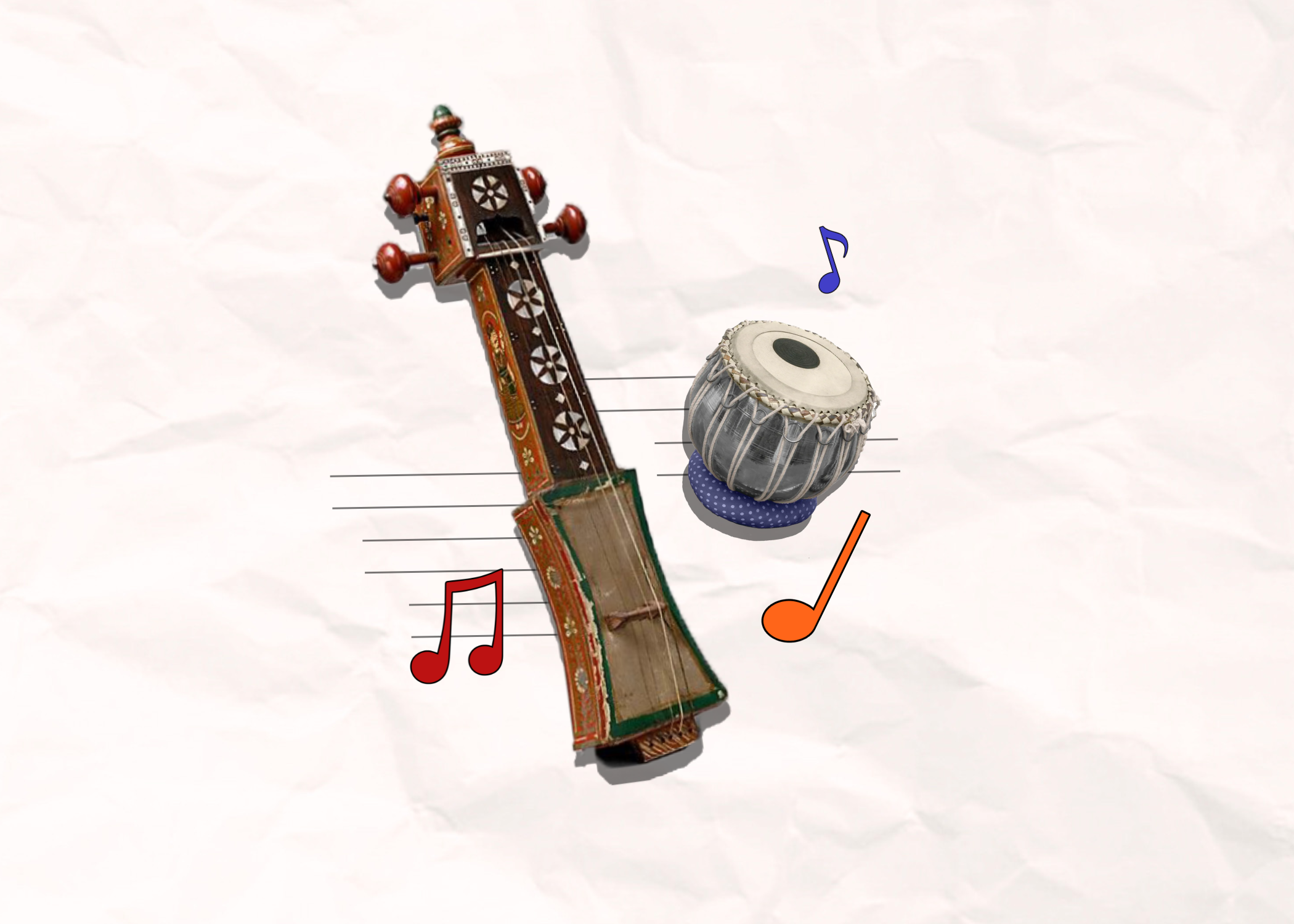
At the end of a cold, snowy Monday night in February, Haverford students and community members gathered in Jaharis Recital Hall to hear Suhail Yusuf Khan, on the sarangi and voice, and Aqeel Bhatti, on the tabla, perform “Sounds of Heritage: A Concert of North Indian Classical Music.” Khan is a renowned hereditary sarangi player who earned his Ph.D. in ethnomusicology from Wesleyan University and has held music residencies all over the country. Aqeel Bhatti is a renowned tabla player, performing all over the globe, and a faculty member of the Department of South Asian Studies at the University of Pennsylvania.
The night started off with Raag Maru Bihag. In Northern Indian classical music, raags are structured melodies that vary depending on the time of day or season they are meant to be played. Raag Maru Bihag is an evening raag that portrays love, compassion, and longing, and was performed by Khan and Bhatti in three compositions: one slow, one medium, and one fast. Khan said that he hoped the audience would feel the “elasticity of time” in the difference of compositions.
The difference in the tempos between the compositions allowed for a beautiful variation of emotion that ranged from melancholy, to playful, to frantic —all different facets of love. What stood out most during this raag was the interplay between the tabla and sarangi. With this piece in particular, the tabla and sarangi felt as though they were in conversation with each other, the dynamics of one instrument complementing the other.
The second raag was the Raag Basant, a raag for the spring. Khan learned this piece from his grandfather when he was six years old, and his expertise with the music shines through. This is the only piece where Khan, in addition to playing the sarangi, sang along with the music. Sarangi, in Northern Indian classical music, is the only instrument that also requires vocal training in order to, as Khan describes, “make the instrument as your own voice”.
Khan’s singing and playing were the true highlight of this piece. The lyrics, as he partially translated, are meant to emphasize the joy in the arrival of spring, but this is clear even without translation. Both his voice and the sarangi exude joy throughout every moment of the piece, filling the room with excitement and glee.
The final raag was a folk version of Raag Khamaj sung in the Indian state of Uttar Pradesh. This is about the mischievous god Krishna as he makes fun of female goatherds, or gopis. The music is like a conversation between the gopis, who question Krishna’s actions, and Krishna, who responds by saying he is doing what he is meant to be doing.
Slightly slower, yet playful and mischievous, this melody was, for me, the most beautiful of the night. Although the other pieces are more complex, the simplicity of this piece is what really lets the tones of the sarangi and the tabla shine.
At the end of the recital, Khan explained that the translation of the word sarangi means “hundreds of colors.” This, to me, is the perfect word to describe this instrument because it is played, and its beauty feels vibrant and expansive. So, to describe it instead as hundreds of colors feels fitting. The music of the sarangi, accompanied by the tabla, feels as though it transcends words.
