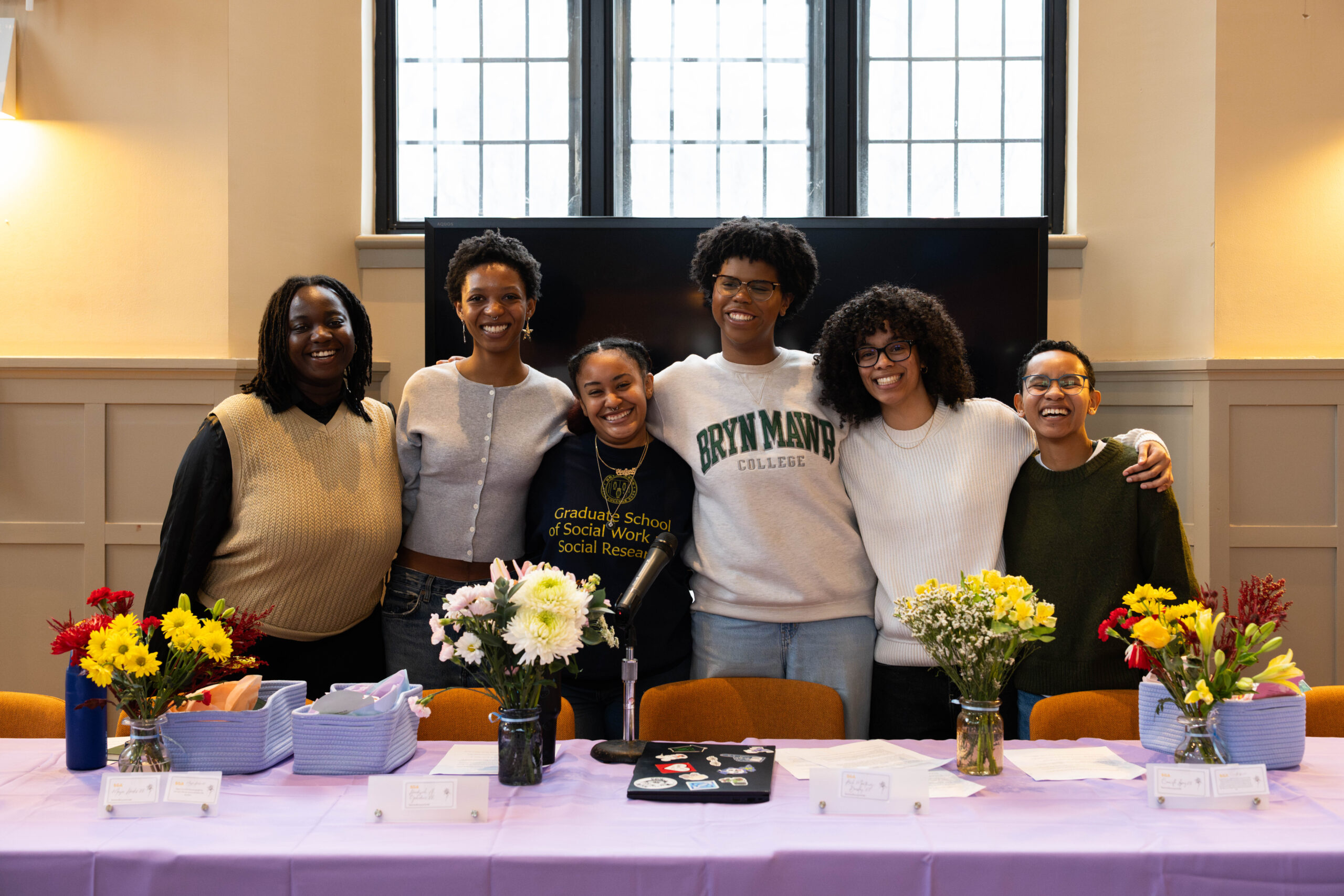
In celebration of Black History Month, SGA hosted a Black Excellency Panel celebrating six Bryn Mawr seniors. The panel was co-organized with forthcoming SGA co-presidents Angelique Lee ’27 and Autumn Kelley ’27, who will be the second Black SGA presidents in Bryn Mawr’s history.
On Sunday, Feb. 22, around 60 members of the Bryn Mawr community gathered in the Campus Center to hear from Jasmine Marshall, Camille Lopez, Hadiyah Al-Gahdari, Maya Hicks, and Gaelle Isophe. Unable to attend, Lordina Oduro was celebrated as an honoree panelist.
Black History Month coordinator Kaili Martinez-Beasely ’27 served as moderator, asking guided questions written by SGA Social Justice and Equity Head Zara Kepler ’28. Kicking off around 3:40PM, the event started with a shout-out to recent efforts to establish a Black Studies major by students including Lee, Martinez-Beasley, Kepler, Elliott London ‘28, and Celia Perkins ‘29. Next, Martinez-Beasley introduced the panelists, and asked the first question: “What is something that brought you joy in your work or leadership here in your time at Bryn Mawr, and how has it shaped who you are?”

Marshall, a Mellon Mays undergraduate fellow and co-coordinator of Black at Bryn Mawr, answered first. She referenced her fondness for meeting and working with other students, saying that she particularly appreciated “getting to interact with a lot of people, especially students of color.”
Lopez, a Posse scholar, co-treasurer of the Bryn Mawr College African and Caribbean Student Organization (BACaSO), and a member of the Writing Center’s leadership team, followed. She spoke about her work at the Writing Center, and highlighted the importance of encouraging students during the writing process, speaking to the difficulties that first generation students may face “finding themselves in their writing and believing in themselves when it comes to that”
A student in the undergraduate Sociology department and the Bryn Mawr School of Social Work, Al-Gahdari stated that “being able to cultivate a community where everyone felt included” as a Community Diversity Assistant was a turning point for them.
Hicks, a multimedia artist, highlighted her time as a board member of Zine Club. Referring to the club as a personal outlet, she said “it’s nice to have a dedicated time for doing art.”
Captain of Bryn Mawr’s African Diaspora Dance Team AJOYO, secretary of BACaSO, and AMO Coordinator at the Impact Center, Isophe spoke more broadly to all of the social connections she has made during her time at Bryn Mawr.
The next question Martinez-Beasley posed to the panelists was, “Along with joy, what is something that you’re proud of from your time here?”
Marshall responded that she was most proud of her contributions to the expansion of Black at Bryn Mawr, now a “household name” in the community.
Having lived in the ILLC for three of her four years at Bryn Mawr, Lopez expressed that she was most proud of her role as a community member— she explained that she knows almost everyone else who lives on the hallway.
Al-Gahdari communicated that they entered Bryn Mawr with “imposter syndrome,” but noted their growth since they entered Bryn Mawr, saying “something I’m proud of from my time here is taking up space,” crediting the Africana Studies department for encouraging this confidence.
Hicks reflected on her experience in the 360: Energy Afterlives program, during which she traveled to Alaska. She had been “wary of doing hard things,” but left the program feeling proud of her work and the relationships she had cultivated.
Finally, Isophe highlighted the work she and fellow students had done to revive AJOYO over the past three years.
Martinez-Beasley’s third and final question asked the panelists what advice they might offer to underclassmen.
Isophe responded, “Your experience of college is what you make of it,” encouraging students to find the activities that bring them comfort.
Hicks and Al-Gahdari encouraged students to explore and take advantage of the opportunities around them, and Lopez communicated the importance of finding community, saying “college is too hard to […] do it by yourself.” Marshall agreed, advising underclassmen to look for community in clubs and affinity groups.
Concluding the panel, Martinez-Beasely and Kepler awarded each of the panelists with flowers and encouraged students to get involved with the coordination of the Black Studies major. After a round of applause, students in the audience stuck around to speak to the panelists, enjoy refreshments, and read the fliers posted around the room celebrating Black community members.
