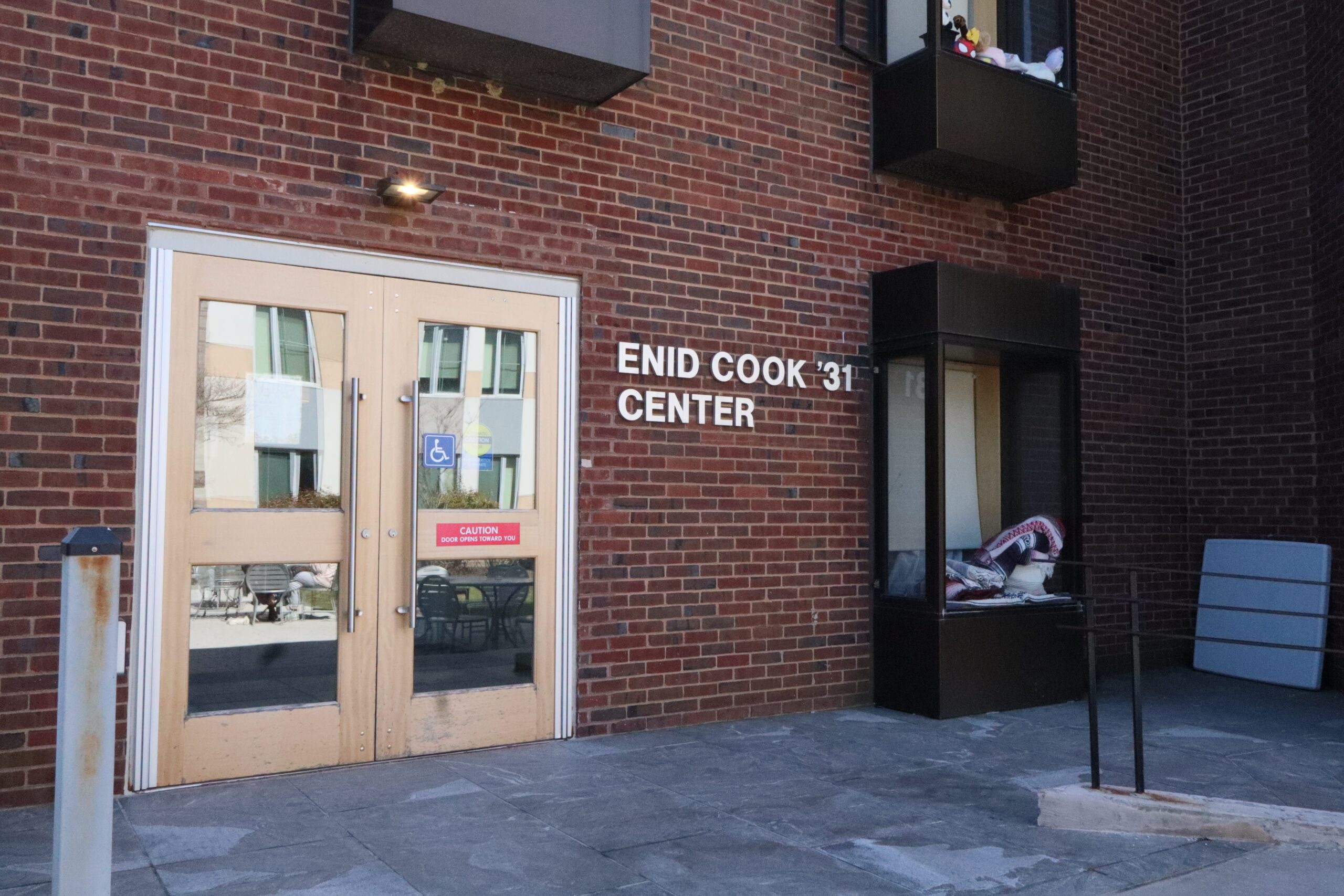
A History of the ECC and Perry House
The Enid Cook ’31 Center (ECC), Bryn Mawr’s Black Cultural Center and residence hall, is the product of decades of student organizing.
In 1962, Bryn Mawr College purchased the Perry property, which operated as a Spanish-language residence from 1963 to 1972. In 1970, a coalition of students staged a sit-in and issued ten demands, including the creation of an African American house to serve as a cultural center. Students suggested that Spanish House be repurposed for this use.
Perry House became a central space for Black students and, later, Latinx students. In 1998, Kwanza Price ’00 raised concerns about the building’s deterioration and called for institutional investment in a stronger cultural center. By 2008, Mujeres* joined Sisterhood and BACaSO in residence.
In 2012, the College announced that Perry House would be taken offline, prompting renewed student organizing. The Student-Housing Options Committee was formed later that year, and by 2013, trustees approved plans for a “New Perry” within a larger housing project. The renovated space opened in Fall 2015 as the Enid Cook ’31 Center, named for the first Black woman to graduate from Bryn Mawr.
The ECC is currently affiliated with four Alliance of Multicultural Organizations (AMO) groups: Sisterhood*, Mujeres*, BACaSO and Zami+. The center is open to members of affiliated groups and students who identify as Black or Latinx. Non-resident students can gain OneCard access by becoming active members of an affiliated AMO.
For Kaili Martinez-Beasley (’27), an AMO coordinator and Sisterhood* E-board member, Perry House is central to the ECC’s identity: “I think it’s always important to emphasize that the ECC came out of what happened to Perry House and the negligence of Perry House by Bryn Mawr College … that being a very big initiative led by Black students and Black alums,” they said.
Brianna Sanchez (’27) and Stephania Guerrier (’26) are the current ECC Dorm Presidents. Richemie Chéry (’27) and Gigi Gil (’26) are the Kitchen and Library Coordinators (KLCs). KLCs are responsible for maintaining the quality and care of the ECC’s kitchen and the library, both shared cultural spaces.
Martinez-Beasley described the ECC as a “hub for cultural exchange, and also safety and belonging in a predominantly white institution … without places like the ECC, the ability to connect with people who look like you and are from similar backgrounds, or who experience marginalization, that just wouldn’t exist on campus,” they said.
Chéry echoed the sentiment. “As a student of color at a PWI [Predominantly White Institution], it can sometimes feel isolating, so being part of a system that fosters belonging and support for other students of color is incredibly important and rewarding to me.”
This year, 10 of the ECC’s 25 residents are first-years. The building has 19 rooms, including 13 singles and six doubles. Returning students apply in the spring, while incoming first-years can apply over the summer.
The ECC and the 2020 Strike
As part of the 2020 strike, the Bryn Mawr Strike Collective issued a series of demands calling for structural changes to the ECC’s funding, staffing and institutional recognition. The final list of demands, which can be found on the SGA website, included:
- Recognition of the ECC as both a Co-Operative and a Cultural Center in the allocation of resources
- An increase in annual funding to at least $100,000 (the fund was raised to $10,000 for the 2020–2021 academic year from a previous amount at or below $5,000)
- The creation of a dedicated ECC coordinator position, separate from Residential Life
- A paid student coordinator position, with a stipend of at least $5,000, in place of the unpaid dorm president role
- Meal plan flexibility for ECC residents, including the option to opt out of the full meal plan or enroll in a partial plan
- Reduced winter and summer break housing costs for international students
Following the strike, a separate ECC coordinator position was established, and funding has increased incrementally. However, most demands remain unmet, including the proposed $5,000 stipend, meal plan flexibility and reduced housing costs.
Sanchez said that funding remains at less than 20 percent of the amount asked for during the 2020 Strike. “People expect a lot for events, and it’s just like, we don’t have the funding,” she said.
“Last semester was definitely hard. Everyone’s really thankful for the extra money from the President’s office, but I’m always wary of giving the President’s office too much credit,” Martinez-Beasley said. “A lot of us really came together to express this frustration with the lack of funding and it was through that collective action of students involved in the AMOs and the ECC that we were able to get that extra funding.”
Viviana Wallace (’27), an ECC Community Board member and student leader across BACaSO, Sisterhood* and Zami+, said that recent advocacy has focused on funding rather than broader policy changes. “If you guys can post us online, use us for advertising to get people to apply here and give them money, you can minimally give us more money,” she said. “We’ve been so focused on that, especially this past semester being a budget crisis, we haven’t really pushed them on other demands.”
“Even though these things haven’t happened yet, in general, things move so slowly at Bryn Mawr,” Martinez-Beasley said. “Of course, you set up the initiative, but then … it’s really difficult to put time into that and then also further the initiatives of the student demands.”
“I think making demands as students is also very central to the message of the ECC,” Martinez-Beasley added.
The ECC Today: Programming and Events
The ECC’s programming is largely student-led. Major events include Legacy Weekend, which welcomes alumnae and celebrates graduating seniors, and Friendsgiving, a campuswide potluck. This year, Sisterhood* is hosting Black Love, a rotating Tri-Co event.
Sanchez, who also serves as president of Mujeres*, said she pursued the role to be more involved in event planning.
“My responsibilities include making sure the space is being taken care of, reservations of the lounge, and helping plan Friendsgiving and Legacy weekend, in addition to what DPs [Dorm Presidents] in other dorms are in charge of,” Sanchez said.
KLCs collaborate closely with Dorm Presidents to organize community events, senior gifts and other initiatives that strengthen connections within the ECC. Chéry and Gil are currently working on a library project that involves creating an archival system for the ECC and AMOs. Chéry hopes that the project will “serve as a lasting resource that preserves the history and impact of the AMOs, while also ensuring that future generations can continue to build on that legacy.”
“I was motivated to take on this position because I genuinely enjoy being involved in my community and wanted to develop leadership skills in spaces that are meaningful to me,” Chéry said.
“There’s kind of this idea that the ECC is only exclusive to Black and Latinx students, and while they should definitely be the ones taking up the most space, I think it’s more than just that,” Martinez-Beasley said. “People should also attend open events to show their allyship and support, since a lot of funding for those types of events comes out of whether we’re able to get a good audience base out of them.”
“Going to open ECC events is really important and making your presence there known is really important, but also respecting Black and Latinx students in and outside of the ECC is a really big part of the ECC’s mission, as it’s supposed to create belonging beyond just that space on campus,” they added.
Wallace said funding decisions should not rely solely on attendance. “Obviously, if no one comes to Friendsgiving, there’s no point in spending thousands of dollars on food,” she said. “But for some of the traditional events … it should be that and other factors like cultural importance.”
Looking Forward
Martinez-Beasley hopes to see greater institutional transparency about Bryn Mawr’s racial history. “I think Black at Bryn Mawr should be a required tour because the regular tour leaves out a lot of the tensions that existed throughout Bryn Mawr culture,” they said. “When they did talk about places like the ECC, they really won’t mention Perry House, or the amount of responsibility that fell on Bryn Mawr admin for the destruction of Perry House.”
Wallace said administrative oversight can slow decision-making. “They want us to include them on every decision we make, they want to be in the loop about everything,” she said. “They’ll either take very long to respond, or be like ‘No, I think you should do it like this.’ The pushback we receive from administration also doesn’t help.”
Sanchez pointed to ongoing facilities issues as another area of concern. She cited issues with the stove burners and the oven, as well as the lack of a food disposal. “The entire kitchen could use remodeling,” she said. “We would put in the facilities requests, but it means that it would take a really long time for it to get done.”
“So much just boils down to them being like, ‘Oh, why aren’t you guys speaking out about it,’ but it’s like, we do,” Sanchez said. “Nobody actually takes the time to listen.”
Despite these challenges, Sanchez said that student collaboration remains strong. “Working with students is very easy because we’re aware that we’re all busy, so we want to get back to each other and get things done fast,” she said. “It takes a little longer when doing events with staff or having to communicate with staff.”
Martinez-Beasley emphasized the importance of sustained advocacy, even when change feels incremental. “Even if, unfortunately, everything at Bryn Mawr is very slow, things are slowly turning around a bit. Keep the foot on the gas pedal, keep holding admin accountable, keep having these conversations,” they said.
“Always recognize the power of coalition-building,” Wallace said. “So much is done through making connections with people, and there’s so much more power in larger numbers.”
Martinez-Beasley encouraged students who want to get involved to reach out directly to ECC residents and AMO members. “People who live in the ECC are always more than willing to talk to people who are interested,” they said. They also recommended joining an affiliated AMO and serving on the ECC Community Board, which is open to all students. Students can follow @bmc_ecc on Instagram to stay updated on upcoming events.
A letter to the editor was submitted in response to this article.
