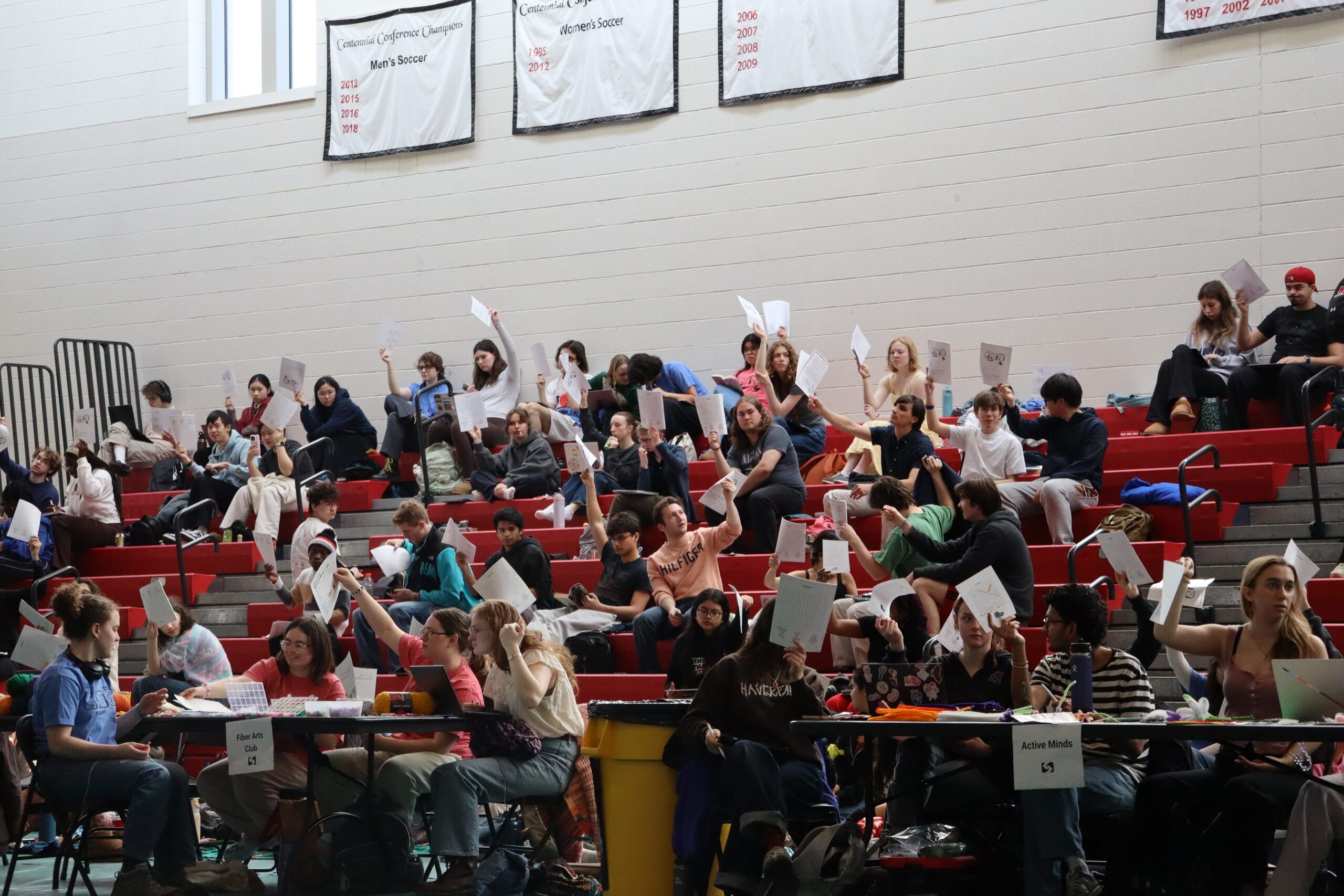
“The only thing you can ever really expect from Plenary is the unexpected,” said Students’ Council Co-President Ben Fligelman ‘26, minutes after the doors to Gooding Arena opened and Haverford students started filing in.
With a quorum of 898 students reached at 2:27 p.m. on Sunday, Haverford’s SEPTA-themed Spring Plenary began, complete with a dance performance from Bounce, “cafe car” stations for snacks (as per the SEPTA theme), and t-shirts available first-come first-serve.
Six resolutions were proposed, perhaps the most anticipated of all being Resolution #6 to rename the Howard Lutnick Library in the wake of the ‘83 alumnus’s revealed connection to Jeffrey Epstein earlier this year.
Given the sensitive nature of the resolution, various resources were provided for the student body for the duration of Plenary, including tables outside of the arena with de-stressing activities where students could take a break from upsetting topics while not counting against quorum. Dispersed around the event were also three confidential sexual health advocates, a Health and Wellbeing (HWB) Peer Educator, and five members of the Haverford Survivor’s Club (HSC) E-Board.
Statements read during Plenary’s opening remarks by Sabrina Glass-Kershaw, the Director of the Office of Health and Wellbeing Education and Paeton Smith-Hiebert ‘26, Co-Head of HSC, outlined these resources and advertised both groups as continuing places of solace on campus even after Plenary concluded.
After community comments asking for student input on the presidential search committee, a reminder of events being held for Sexual Assault Awareness Month, and an advertisement of the upcoming Drag Ball, Co-Presidents Sarah Weill-Jones ‘26 and Ben Fligelman presented the Rules of Order and the State of the Ford.
The State of the Ford this year reflected on the community’s values and the change Haverford is experiencing with the new Honor Code. Weill-Jones emphasized that the school community’s genuine commitment to “trust, concern, and respect” made the college a special and unique place.
“But Haverford can only be such a place if we as a community continue to commit ourselves to it. That means showing up in big ways, and small ones,” Fligelman cautioned. This reminder rang true throughout Plenary, which was paused twelve times due to failure to meet quorum.
“Maintaining our community also means being critical of it,” Weill-Jones added, reminding students that Student’s Council was always a resource for the community to voice concerns throughout the year. “We as Co-Presidents are always open to hearing what you have to say.”

Resolution #1: Efficient Election Procedures & Additional Constitutional Updates
With that, Plenary commenced with the first resolution, concerning the role of the Students’ Council librarians, as well as the procedures for election disputes. The resolution was presented by Ian Trask ‘28, and Zoe Hartmann ‘28, both Students’ Council librarians, and Ellison King ‘29, an Elections Coordinator.
The changes made included reducing the term length of the librarians from three semesters to one academic year, and they are no longer recommended to have at least a year of experience on Students’ Council prior to their appointment. Along with this new term, there is a training period after the librarian is appointed in March. The librarians also now have greater budgeting responsibilities.
The resolution also took out the requirement that a Special Plenary must be called in the process for disputing elections. A Special Plenary requires 75% of the student body to be present, which makes it nearly impossible to dispute elections. Instead, Elections Coordinators and Students’ Council librarians would review the situation to determine the best course of action.
There were two questions asking for further reiteration regarding specific details of the resolution. Additionally, Kabir Hinduja-Obregon ‘26 raised his concern that power throughout the election process would be unbalanced because the Elections Coordinators would no longer be the only ones overseeing elections.
Trask responded that the Elections Coordinators would oversee most elections, and this procedure was only for disputed elections. He also noted that two elections have already been resolved in the process outlined in the resolution.
“We’re basically just solidifying what our process has been,” Trask said.
After the question and answer portion, there were no pro-con statements and the resolution passed with a two-thirds majority.
Resolution #2: Transitioning the COML Role to a Student Worker Position
Resolution #2, presented by Community Outreach Multicultural Liaisons (COMLs) Eliana Kim ‘28, Esme Dosey ‘28, Isaac Kemokai ‘28, and Amelia Spielman ‘28, concerned the transition of the COML role to a student worker position. The resolution aimed to address recent COML elections that failed due to lack of candidates and the lack of adequate training time for the role.
Passed with no objections, this resolution guarantees that COMLs will no longer be elected, but rather hired with the input of past COMLs to ensure that candidates can successfully fulfill their roles.
Resolution #3: Updated Alcohol Policy
Resolution #3 consisted of updates to the Alcohol Policy and was presented by the Joint Student-Administration Alcohol Policy Panel (JSAAPP) Co-Heads Jackson Cannon ‘28 and Isabela Azumatan-Aceituno ‘28. The resolution, according to them, would not change day to day activities or procedures, but would rather “provide the student body with accurate and up to date information” and also clarify existing rules. The resolution also added an endorsement of harm reduction policies.
The Q&A portion of Resolution #3 included a concern from Charlie Harris ‘28 about the misalignment between the Alcohol Policy and the actual practices of the school community. Harris specifically cited the prohibition of the sale of alcohol listed in the policy, which according to him still occurred regularly at campus social events. The response clarified that according to Pennsylvania state law, the sale of alcohol was prohibited and social event hosts were not allowed to advertise any sort of alcohol in their advertisements.
There was also a request for clarification about the wording of Event Policy as to whether all events with over twenty attendees had to be a registered social event or if that was simply the minimum number for a gathering to be considered. Azumatan explained that any event expected to have twenty or more people in attendance had to be registered.
Cannon then brought forward a friendly amendment to his own resolution, addressing concerns over the resolution “los[ing] some sense of shared stewardship within the community.” The amendment read as follows:
Additionally, alcohol consumption can lead to littering and untimely loud noises, which affect the students and the conditions of the grounds. We recognize it is in all of our best interests to resolve these issues to preserve the student wellbeing and the college’s ecological environment.
This amendment passed, and with no pros or cons brought forward, Resolution #3 was passed with a two-thirds majority.

Resolution #4: More Effective Budgeting Committee
Resolution #4 for a More Effective Budgeting Committee, presented by Stu-Co Treasurers Ben Perez-Flesler ‘27 and Sophia Goss ‘28, detailed updates to the membership and responsibilities of the Budgeting Committee.
The resolution would replace the current Budgeting Committee, currently composed of the Stu-Co Executive board, with Officers of the Academics, Arts, Athletics, Campus/Student Life, and Multiculturalism.
According to Goss and Perez-Flesler, this change would “more effectively balance workloads and [delegate] tasks.” Additionally, it would ensure that the people making budgeting decisions would be more directly involved with the clubs and activities they were budgeting for.
During the Q&A portion, Isabella Otterbein ‘26 asked why the Budgeting Committee was being limited to just treasurers and officers.
“Replacing the Stu-Co [board] with officers will just cause the same issues of workload,” Otterbein said.
“This would balance workload because officers currently have fewer responsibilities than Stu-Co people,” Perez-Flesler responded. He also indicated that having too many people on the board would be “a mess.”
Jonah Paterson ‘26 and Victoria Haber ‘26 both approached the mic to share pros. Patterson applauded the Co-Treasurers for their work this year and claimed that “having officers on the Budgeting Committee would do wonders for student engagement.”
Haber pointed out that this process had been done in past years at Haverford and therefore had an existing precedent.
With no amendments brought forward, Resolution #4 passed with a two-thirds majority.
Resolution #5: Readable & Procedurally Improved Honor Council Charter
The fifth resolution was presented by Sofie Quirk ‘28, Ben Perez-Flesler ‘27, Jonah Patterson ‘26, and Ian Trask ‘28 and aimed to make the Honor Council Charter more readable and redesignate responsibilities within the Honor Council so that proceedings could be more quickly resolved.
Under the new resolution, Honor Council Co-Secretaries would no longer be elected, and instead would be appointed within Honor Council to ensure they already have the necessary training and experience for the role. This change was made to address difficulties reaching quorum in the standalone Co-Secretary election, which delays other elections and Honor Council proceedings. The resolution allows Co-Chairs to designate other members of the Council as case chairs as well so that the workload of Honor Council cases are more evenly distributed.
In order to give students more involvement in serious Honor Code violations, the resolution also re-introduced the procedures for a Joint Student/Administrative Panel that could serve as an alternative to Dean’s Panels.
While there were no questions, during the pro-con statements Deven Abrams ‘26 spoke against the resolution, arguing that Honor Council proceedings need to be longer in order for the student body to be aware of them.
“If we shorten it drastically and make it super concise, it will take away from the idea of transparency,” Abrams said.
Patterson responded that the changes do not make Honor Council less transparent, and that they simply combined repetitive procedures.
Additionally, Jack Feinstein ‘26 spoke in favor of the resolution, arguing that by making the charter shorter, more people will be willing to read it and understand it, thus increasing transparency.
With no amendments proposed, the resolution passed.
Resolution #6: Rename the Library
With the passing of Resolution #5, the long-awaited Resolution #6: “Rename the Library” was brought forth by Ian Trask ‘28 and Jay Huennekens ‘28.
“This resolution is essentially a statement from the students,” Huennekens had said in a comment to the Bi-Co news before Plenary began. Both Huenneken and Trask added that they had received a lot of positive feedback throughout the process of writing the resolution and collecting signatures.
Resolution #6 was written and brought forward in the midst of increasing debate around the school’s association with Lutnick.
“We had good and productive meetings with [Raymond] about a month ago, where we gave her our first draft of the resolution,” Trask said. The pair highlighted that their final draft was the result of a collaborative effort between them, Raymond, and Vice President Jesse Lytle. This came after many in the community critiqued Raymond’s initial response to Lutnick’s involvement with Epstein.
In their presentation at Plenary, Trask and Huennekens reaffirmed their opinion that keeping Lutnick’s name on the library would be “detrimental to the values and the standing of our college.”
The Q&A session prompted a question about potential repercussions of the name change, especially due to Lutnick’s standing as the Secretary of Commerce in the Trump administration, which has historically targeted universities, including Haverford College.
In response, Trask assured that the decision to remove Lutnick’s name was not a political one, but due to his connections to Epstein alone. He also highlighted that the resolution ultimately did not reflect the decisions of administration– it only served a request from the students to bring the idea of renaming the library to the Board of Managers.
There was also a question about whether the resolution extended to the other buildings around campus named after Lutnick on behalf of his family and associates– namely, the Cantor Fitzgerald Gallery, the Gardner Integrated Athletic Center, the Jane Lutnick Fine Arts Center, and the Gary Lutnick Tennis & Track Center. Trask and Huennekens responded that while the focus was on the library due to its frequency of use by the community, the review committee might choose to examine other buildings as well.
One student also asked how the administration would continue to be held accountable after the resolution was passed. Huennekens and Trask reassured students that given Raymond’s involvement with the creation of the resolution, it was unlikely that she and the board would ignore the renaming request.
Several students spoke out during the pros and cons portion, mostly in favor of the resolution, with one concern about how the decision would reflect on students most vulnerable to repercussions from the presidential administration.
With no amendments, the resolution passed with a one-half majority.
Opening Ratification of the Honor Code, Honor Council Charter, & Alcohol Policy
After all the resolutions were presented and voted on, Honor Council Co-Chairs Sofie Quirk ‘28 and Michael Pyo ‘26 gave a speech urging students to remain committed to the new Honor Code after its ratification last fall. Pyo noted increasing academic dishonesty, saying the Honor Council has seen a 38% increase in the number of cases this year, and the two urged students to read and engage with the Code.
“The Code is hollow without the student body behind it,” said Quirk.
Isabela Azumatan-Aceituno and Jackson Cannon also gave a speech about the Alcohol Policy, emphasizing its updates approved in the third resolution.
A student attending through Zoom spoke about the cons of the new Honor Code and its risk of generalization. They argued that some international students use AI in order to improve their English and grammar skills when writing.
Quirk responded that the strength of the Honor Council lay in its individuality. Through the Council, issues such as the use of AI tools are considered on a case-by-case basis in order to determine if a Code violation occurred.
Another student attending through Zoom spoke in favor of the Code, emphasizing that as a disabled person, the ability to have take-home tests is very helpful for them.
All passed with a simple majority.
Reflections
After nearly three hours of procedures, Plenary concluded with all six resolutions passed. Students streamed out the arena doors, stretching their legs, recycling their resolution packets, and making plans for dinner.
“[Haverford] is a weird, fractious, contrary institution,” said Fligelman. “But as long as it stays that kind of place, we have a shot at not just making it better, but making it ours.”
Editor’s Note: Due to the sensitive nature of Resolution #6, the identity of students (unless otherwise noted) speaking during discussions concerning the resolution has been kept anonymous.

