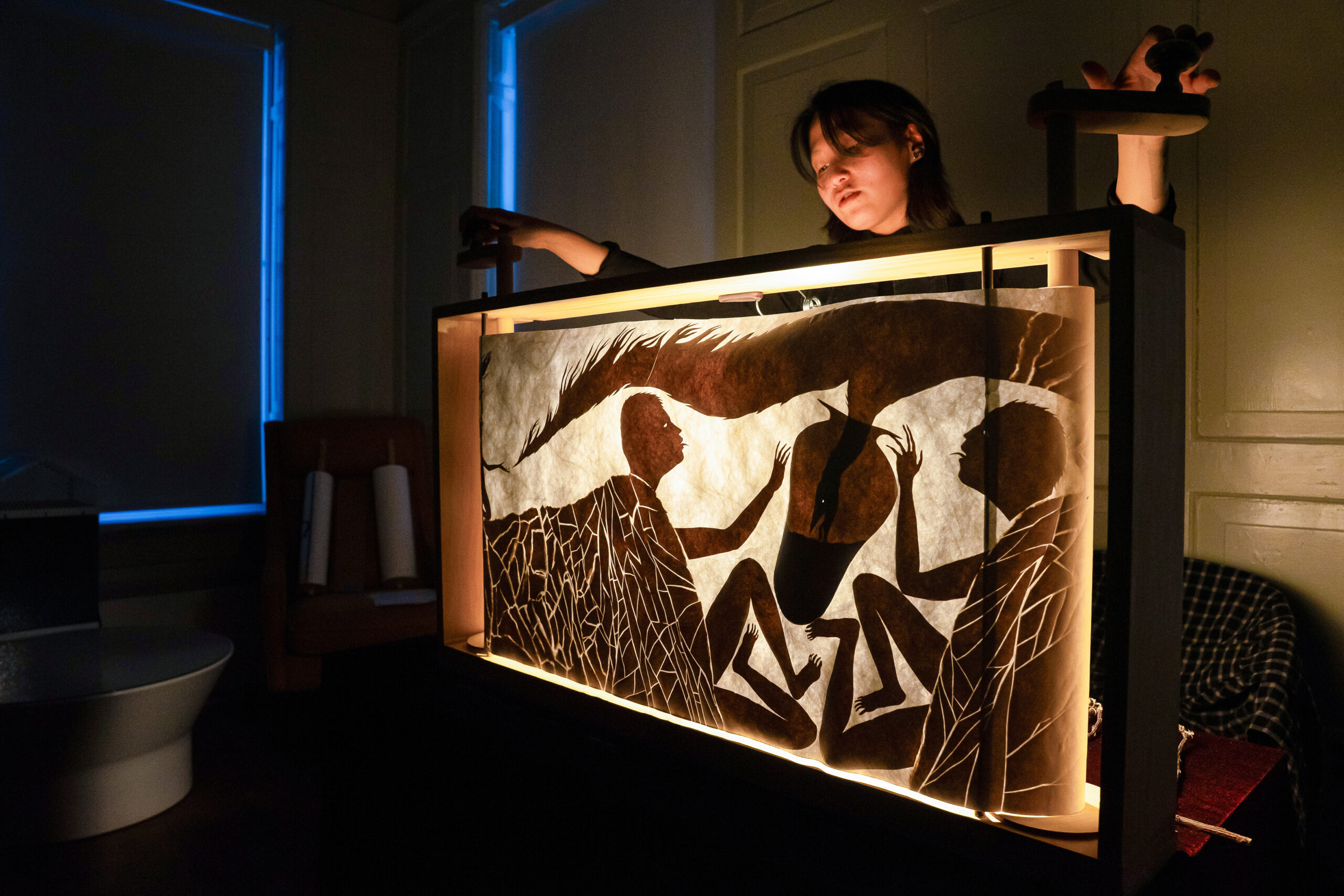
To talk about folk art is to recognize the essential stories human beings have been compelled to tell, for generations, about creation and existence. The work of Maisie O’Brien, VCAM’s Philadelphia Artist in Residence, uses shadow theater and puppetry to tap into folk art traditions and reflect on acts of creation as essential for endurance and survival.
Crankie theater is a storytelling art form consisting of an illuminated box and spools of paper that scroll across the light, casting shadows when cranked. Maisie O’Brien brought their hand-built crankie theater to Haverford this February, marking their second shadow performance through the Hurford Center. O’Brien explained the multiple and global contexts of crankie, which has roots both in East and South Asian cultures, as well as American Appalachian iterations. O’Brien’s own work takes direct inspiration from American folk music and practices, featuring ballads which present stories simultaneously through visuals and song.
O’Brien works as an artist in Philadelphia, teaching puppetry at Temple University and with SPIRAL Q, an art collective which also hosts a Haverford intern each year through a partnership with the Hurford Center. On this most recent visit to Haverford, O’Brien was invited through the course East Asian Puppetry and Performance, taught by Professor Honlang Huang.
Maisie O’Brien’s crankie theater performance was made up of three pieces: ‘Solomon Grundy,’ ‘The Artist,’ and ‘What Will We Do?’ In between each performance, O’Brien took questions from the audience, explained their method and inspirations, and gave context for the creative decisions that went into each particular piece.
In ‘Solomon Grundy,’ O’Brien iterated on a classic English rhyme, sung to teach children the days of the week. They expanded the lyrics to include days of the month as well. This piece was eerie yet darkly humorous. Playing with story of the life and death of the fictional Solomon Grundy, O’Brien’s shadowy scenes include a woodsy thicket that evolves, as the scene cranks by, into an umbilical cord, and later crows pecking at the toes of his corpse. In one striking moment, the scene transformed into a completely blacked out, shadowy sky, in which the only lights coming through were pin-pricked stars. The constraints of shadow theater seemed to yield the most exciting artistic adaptations, as O’Brien subverted our expectations of the functions of shadow and light.
In ‘The Artist,’ an original work and one that includes the first song O’Brien ever composed to accompany a shadow performance, the titular character is an artist who cuts out shapes of things they see in real life, attempting to capture all the beauty of the world in art and “keep everything the same.” These scenes were primarily made up of intricate, nearly symmetrical cut-outs. In ‘The Artist,’ a piece which alludes to the artistic project of shadow theater itself, O’Brien yet again breaks expectations. They combine crankie theater with shadow puppetry by holding separate puppets, such as scissors and their own hands, in front of the light, casting shadows through the illuminated screen. As the character’s creative impulses grow into the desire to cut out everything, the word stops– and the screen stops scrolling.
In ‘What Will We Do,’ O’Brien uses the folk song ‘What Will We Do When We Have No Money?’ (inspired by the Mary Delaney version recorded in 1973) to explore themes of hope and redemption in a world that feels tragically apocalyptic. Reflecting on this piece, O’Brien spoke about the hopelessness felt by many today, in the face of horrors like the mass deportations under ICE and genocide in Palestine. They noted that their work is deeply tied to material reality, stating that art is shaped by the artist’s perspective, originating from a “politicized, racialized body.”
