What drives exclusion, hatred, and cruelty? Bryn Mawr’s Shakespeare Performance Troupe production of “Seven Against Thebes & Antigone” suggests that the answer is love. “Seven Against Thebes & Antigone” ran April 16, 17, and 18 in Rhodes Dining Hall. “Seven Against Thebes,” written by Aeschylus, follows the two brothers Eteocles and Polynices fighting over the city of Thebes— Eteocles defending the city and Polynices besieging it. The two brothers end up killing each other, leaving their sisters Antigone and Ismene in mourning. “Antigone,” written by Sophocles, demonstrates the fallout of Seven Against Thebes as it follows Antigone trying to give her brother Polynices a proper burial, after it is forbidden by King Creon.
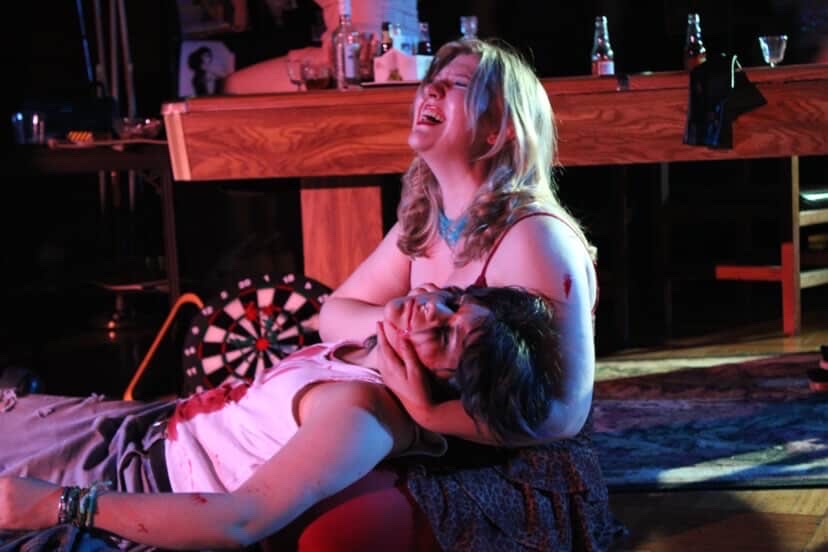
One twist on these two ancient plays is that, in this production, they were both set in a gay bar. The characters are fashioned in a Y2K aesthetic. The set was in conversation with the darkness of the themes of Seven Against Thebes and Antigone. The joy, community, friendship, and love that are found gay bars are also present in the darkness, hatred, fear, and cruelty that is seen in these plays. These beautiful sanctuaries can likewise be transformed into sites of conflict.
“Seven Against Thebes” made terror and fear feel tangible, as if it were another member of the chorus. What fueled “Seven Against Thebes” was the relationship between Eteocles and Polynices. Grace Muller (BMC ‘28) as Eteocles made the character feel powerful yet vulnerable, letting the audience feel Eteocles’ confidence slowly crumble as he eventually decides to battle his brother. The pain and hatred shown in the relationship between Eteocles and Polynices is compelling and tragic.
While “Seven Against Thebes” filled the audience with terror, Antigone did the same with dread. The ending of Antigone felt inevitable but also entirely avoidable, which made it all the more dreadful. The true through-line between the two plays was Polynices, portrayed by Plummy Carter (BMC ‘27). Each word that Carter spoke carried weight and portrayed such sorrow and anger. Carter’s expressions and reactions throughout the entirety of Antigone made Polynices’ torment and sorrow feel urgent and real. Kate Nakahara (BMC ‘27) as Antigone was able to manifest the anger, grief, and sorrow present in the play as a form of love. Love, heedless of right or wrong, drove all of Antigone’s actions and was clearly shown through Nakahara’s performance.
The highlight of SPT’s performance of “Antigone” was Creon. Creon, portrayed by Margaret Schedler (BMC ‘27), demonstrated the themes of the play with every movement and reaction. Schedler’s portrayal is truly captivating; Creon should be the villain, but Schedler made the character feel like the heroine. Creon’s blind pursuit of a twisted sense of justice is tragic because, in her attempt to protect what she loves the most, her son, she ends up losing it.
Annika Bergstrom (BMC ‘26), the director of “Seven Against Thebes & Antigone,” emphasizes the role that love plays in such tragedy. In the director’s note, they urge the audience “to understand even the worst of us as people. To remember that all this anger used to be love.” “Seven Against Thebes” and “Antigone” are both tragedies, and SPT’s production also reminds us that they are love stories, too.
Shakespeare Performance Troupe’s Antigone: Is love at the heart of tragedy?

Visited 228 times, 1 visit(s) today