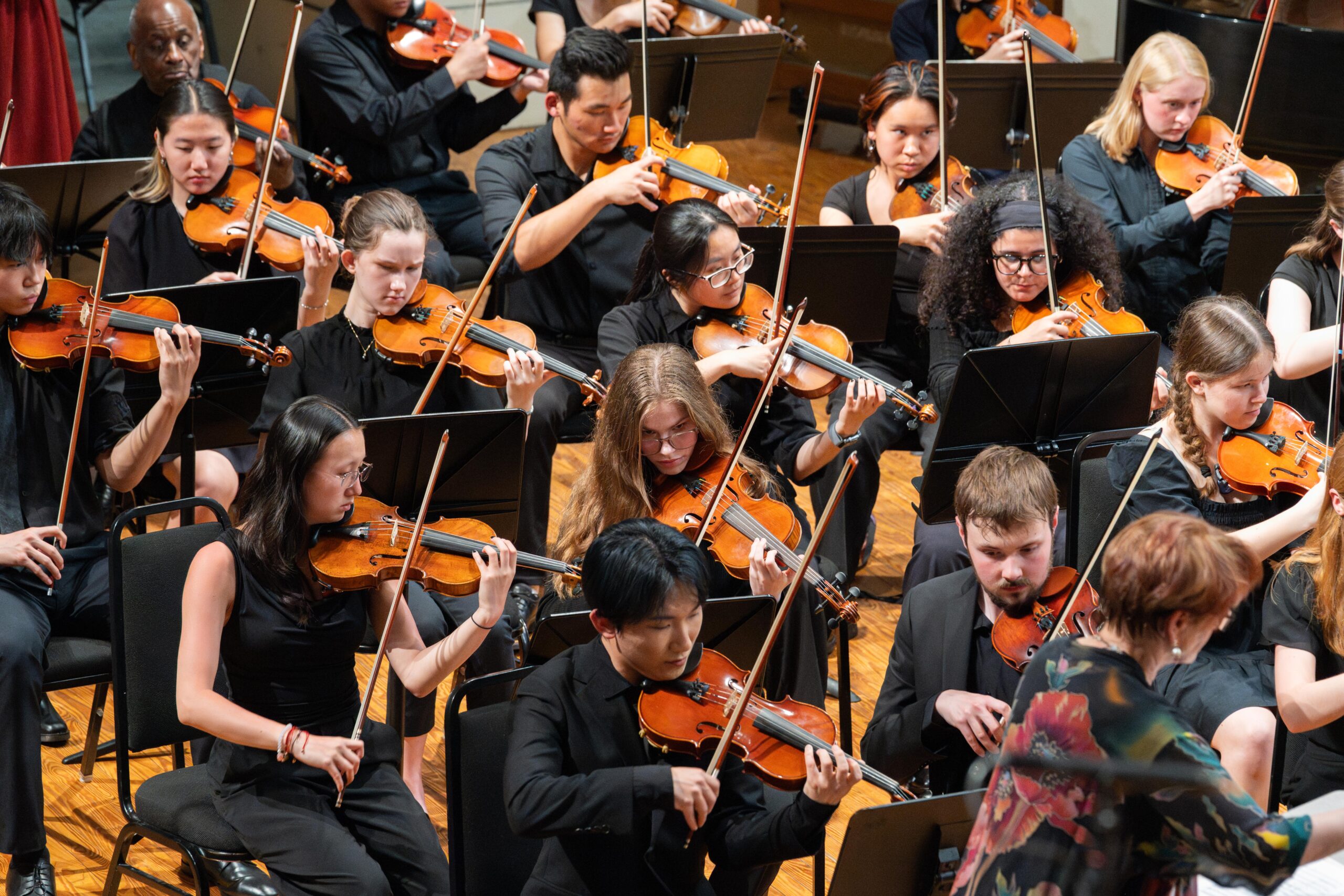
The Haverford-Bryn Mawr College Orchestra, alongside pianist Yuxin Li (BMC ’28), performed in Haverford’s Marshall Auditorium on April 17. Their spring concert consisted of Piano Concerto #1 in E flat Major, S. 126, composed by Franz Liszt (1811-1886), and Symphony No.5 in D Minor, Op. 47, composed by Dmitri Shostakovich (1906-1975).
The auditorium was lit with a moody ambiance, and the sound of musicians running scales echoed across the rows of seats. As the orchestra prepared to begin the concert, the Bi-College 2026 Concerto Competition Winner, Yuxin Li, took her seat at the grand piano. Li, who has played the piano since age five, is studying classical piano with Anna Kislitsyna at Haverford College and joined the orchestra for their Piano Concerto. She expressed her musical talent throughout high school, receiving several awards, scholarships, and recognitions, and currently participates in multiple chamber groups in the Bi-Co.

Li described her experience preparing the piece with the orchestra as challenging yet rewarding. Before collaborating with the orchestra, she had already been playing the piece for a number of months. Li explained, “I’d listened to other people play it a thousand times, and I’d heard myself play it even more.”
Despite her fluency with the concerto, she experienced fatigue and discussed her struggles with keeping the piece exciting. “Oftentimes, I find that playing the same piece for an extended period of time usually leads to immense practice fatigue, and you reach this state where playing it over and over is the most interesting thing you can do, and while you know it isn’t as good as it could be, there’s nothing you want to work on.”
However, Li was able to persist through these difficulties, ultimately gaining a new perspective on the piece and delivering a mesmerizing performance.
The concert began with Piano Concerto #1 in E flat Major, S. 126, chosen by Li after seeking suggestions from friends. The piece was characterized by a high-energy, optimistic mood that alternated between moments of soft, romantic finesse and lively piano passages.
The conductor of the Haverford-Bryn Mawr Orchestra, Dr. Heidi Jacob, described the piece as “a fiery piece showing off the superb technique of our pianist.”
Following a short intermission, the orchestra continued its concert with Symphony No.5 in D Minor, Op. 47. The piece was chosen as it was a great way to showcase all of the sections of the orchestra, particularly brass and percussion players. Jacob stated that this piece was an especially difficult one, and that they had to “divide the orchestra at times for sectionals with various professionals leading the brass, the woodwinds, and the string players.”
Shostakovich’s composition is defined by a deeply tense, dramatic, and tragic mood. The piece featured four movements that flowed through tonal shifts, displaying a unique, melancholic story. The piece began with the movement Moderato, with a somber, introspective mood, before moving to its second part, Allegretto, with a witty, light mood. The piece continued to the third movement, Largo, characterized by a quiet, mournful tone, and finished with Allegro non troppo, a highly debated finale that is chaotic, triumphant, and ironically sad. The piece is considered to demonstrate the forced cheerfulness of small victories, masking a deep-seated terror.
Jacob described the piece as a controversial political criticism of the Soviet Union. “The Shostakovicih was written at the height of the Yezhovshchina, of the bloodiest political terrors of the Soviet regime. Parts of the first movement and, in particular, the third movement are haunting and heartbreaking, evoking that era. While it met with approval of the Soviet authorities —the finale, originally thought to be intended to end the work in a glorification of Soviet optimism, has been later thought to be at the very least ironic, or mocking, particularly the biting dissonances heard in the coda of the movement.”
When the concert ended, the crowd erupted with applause. The pieces seemed to touch many in the audience. The orchestra, along with Li and Jacob, took their bows, but not without mentioning a significant part of the evening’s concert: the use of a purple baton. The act of conducting with a purple baton—an idea coined by a world-renowned conductor and the first woman to serve as the head of several major orchestras, Marin Alsop—honors National Women’s History Month, particularly female musicians and conductors in orchestral spaces.


Li noted her own experience with the purple baton and how it arrived at the Haverford-Bryn Mawr Orchestra. “I knew I had to get myself a purple baton, and also almost immediately knew I wanted to ask Dr. Jacob to join in with me on this initiative. She was extremely happy to hear about the campaign and was as excited as I was to be a part of it.”
Jacob’s use of the purple baton continued an inspiring movement that encourages women to participate in historically male-dominated spaces. This concert, in part, for its inclusion of the talented Yuxin Li and remarkable performances of complex material, but also for its employment of the purple baton, fostered a beautifully impactful experience for attendees.
