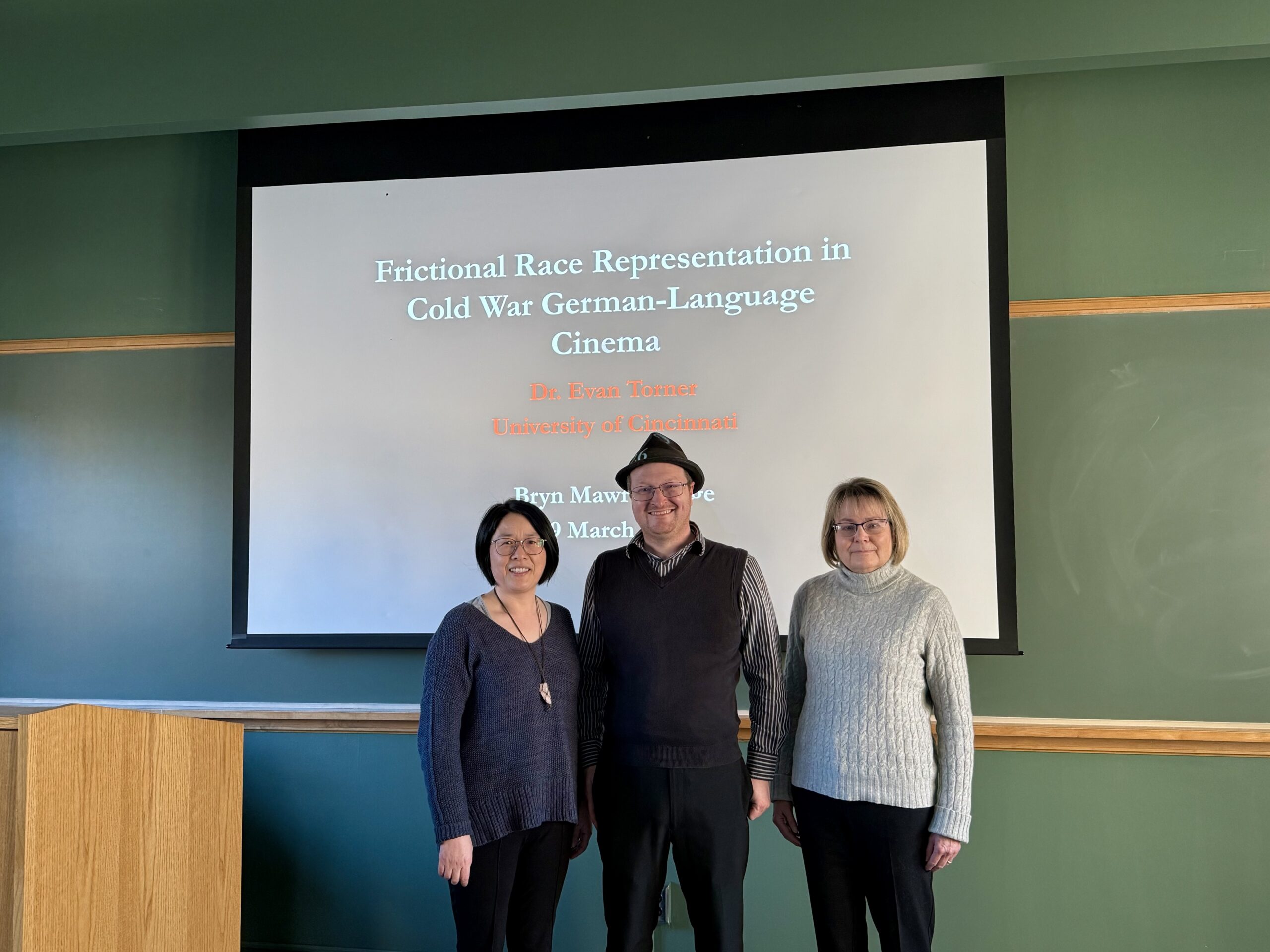
Dr. Evan Torner visited Bryn Mawr College on March 19, giving a talk about frictional race representation in Cold War German cinema. Torner is an Associate Professor at the University of Cincinnati and specializes in German, film studies, and game studies. During the talk, Torner discussed a variety of films from 1949 to 1989, comparing representations of people of color between East and West Germany. “We’re 37 years past the fall of the Berlin Wall, I think we can have these conversations,” Torner stated.
The talk was a part of the 360° Cluster “Europe From the Margins,” which asks the question: “What does Europe look like from the perspectives of those whose voices are usually missing from mainstream narratives – the disempowered, queers, migrant laborers, artists, refugees, and people from Europe’s eastern and southern peripheries?” The cluster includes the courses “GERM B217: Representing Diversity in German Cinema,” “HIST B226: History of Fascism: Then & Now: Topics in 20th Century European History,” and “POLS B205: European Politics: Coming Together or Falling Apart?”
Professors Qinna Shen, who teaches the German course, and Carol Hager, who teaches the Political Science course, stated that they were inspired to create the cluster because “European politics, history, and culture are generally taught from a top-down, Western-centered perspective. Although this perspective has value, in conversation with one another, we decided we would like to take a different approach by foregrounding the voices of marginalized populations.”
During a time of what Torner emphasized as “authoritarian backsliding,” discussions of historical and social issues from this perspective are still relevant and more important than ever. During his talk, Torner pointed towards modern examples of this relevance, for example, the rise of the far-right in German government and the words of the current prime minister, Friedrich Merz, having parallels with racist and xenophobic Nazi attitudes.

Torner argued that the representation of BIPOC in both Eastern and Western German cinema “is littered with the unconscious bias of white-supremacist thinking,” and that “recognition and redistribution would come once the Black German movement formed actual organizations to advance their agenda.”
The event “was a great success and very well-attended by members of the Tri-Co community,” said Shen. In her class, students had already discussed a couple of the films that Torner analyzed. “Torner’s talk was a thought-provoking supplement to our class discussions.”
As part of the 360° program, students also traveled to Vienna, Austria, during spring break to bring their studies to life and connect what they’ve learned to real people and places.
Vienna has a rich political and cultural history. After WWI, the city had a renowned Social Democratic government during the period known as “Red Vienna,” before social unrest led to the dissolution of the government, the subsequent period of “Austrofascism,” and the annexation by Nazi Germany in 1938. Over the years, Vienna has become a hub for immigration as well, particularly from Eastern European countries.

Barbara Tschirnich.
The 360° trip included walking tours, site visits, museum exhibitions, and free time for students to explore the city on their own time. “The itinerary reinforces and enhances what we discuss in the three classes,” Shen and Hager stated.
Highlights included a walking tour of Jewish Vienna, a Queer Vienna tour, talking with a former member of the Vienna State Parliament, and meeting with representatives from the Women’s Advice Center for Migrants. Students were also able to visit locations featured in some of the films they had seen and discussed in class.
Shen and Hager find great value in the 360° Program at Bryn Mawr. “Taking a multidisciplinary approach to a theme enables us to explore it from several different angles at the same time,” they said. “It also encourages us all — professors and students alike — to work toward a common language for interpreting events and positions.”
